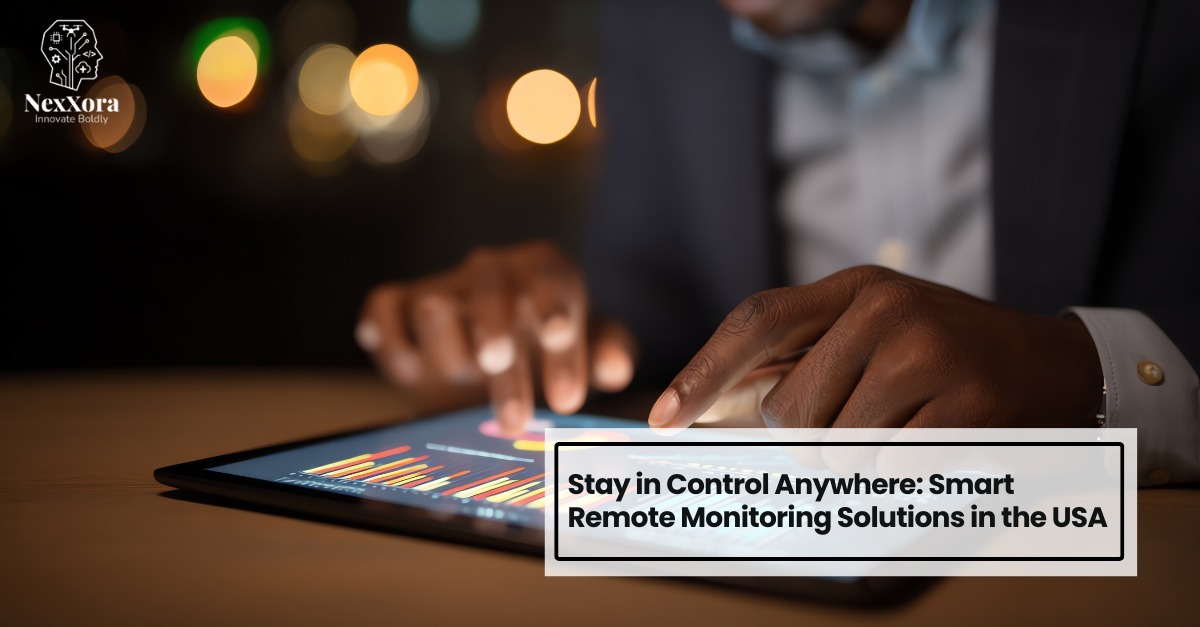

The manufacturing ecosystems in the USA are undergoing a paradigm shift as plants begin to adopt automation, data-driven decisioning, and interconnected operations. In such a scenario, an industrial monitoring platform assumes a pivotal role in facilitating real-time monitoring of machines, processes, and production results as part of advanced remote monitoring solutions in the USA. Unlike conventional monitoring solutions that function in isolation, an industrial monitoring platform leverages edge devices, industrial networks, and cloud computing to provide real-time operational insights.
An industrial monitoring platform enables manufacturers to retain control of their distributed facilities while ensuring efficiency, reliability, and scalability, making it a foundational component of modern remote monitoring solutions in the USA.
- The Role of an Industrial Monitoring Platform in Modern Manufacturing
- Key Capabilities That Define a High-Performance Platform
- Achieving Manufacturing Operations Visibility Across Facilities
- Machine Performance Insights That Drive Predictive Action
- Smart Factory Monitoring Through Data Correlation
- Production Analytics for Strategic Decision-Making
- Industry Applications Across the USA
- Best Practices for Implementing an Industrial Monitoring Platform
- Future Outlook: The Next Phase of Industrial Monitoring
- Why Nexxora Stands Out in Remote Monitoring Solutions
- FAQs
The Role of an Industrial Monitoring Platform in Modern Manufacturing
An industrial monitoring platform is the digital spine of a smart manufacturing environment. It gathers high-frequency data from sensors, PLCs, and industrial controllers, and it converts this data into valuable operational knowledge. This is critical for companies that want greater visibility into their manufacturing operations without adding complexity or manual oversight.
But it does more than gather data. It provides contextual awareness, or an understanding of how machine conditions, process values, and production schedules are related. This level of knowledge enables companies to spot inefficiencies early, react to anomalies quickly, and make operational decisions that are aligned with business outcomes
Key Capabilities That Define a High-Performance Platform
A strong industrial monitoring solution integrates various technical components to provide end-to-end visibility and control. The key functionalities are:
- Secure data retrieval from diverse industrial resources
- Real-time dashboard solutions for equipment and process monitoring
- Edge computing for low-latency processing and filtering
- Cloud analytics for scalability and historical analysis
- AI models for predictive and prescriptive analytics
These functionalities work together to provide continuous smart factory monitoring, enabling operations teams to better control complex production environments.
Achieving Manufacturing Operations Visibility Across Facilities
The visibility of manufacturing operations is no longer restricted to monitoring machine status or line performance. With an industrial monitoring platform, the visibility is extended across production lines, plants, and even remote locations. The operators have a complete view of the performance metrics, downtime incidents, quality excursions, and energy consumption in real time.
The complete visibility enhances the coordination between the production, maintenance, and quality departments. The visibility also enables faster root cause analysis by correlating the operational data with process conditions.
Machine Performance Insights That Drive Predictive Action
One of the most important and valuable aspects of an industrial monitoring platform is the capability to provide in-depth information about machine performance. Rather than simply performing maintenance tasks in a reactive manner or using fixed thresholds, the platform uses continuous analysis of operational patterns to identify early warning signs of potential issues.
Using the principles of vibration analysis, thermal trends, power consumption, and cycle time variations, manufacturers are able to forecast failures before they happen.
Smart Factory Monitoring Through Data Correlation
Smart factory monitoring requires the platform’s ability to correlate data across machines, processes, and environmental factors. An industrial monitoring platform connects production data with other factors such as a shift change, a batch of material, or an operator’s input.
This correlation enables manufacturers to see what has occurred and why it has occurred. Consequently, process optimization becomes a systematic process rather than a trial-and-error procedure.
Production Analytics for Strategic Decision-Making
Advanced production analytics enable the conversion of operational data into strategic intelligence. An industrial monitoring system combines historical and real-time data to provide insights into long-term trends, areas of underperformance, and potential for optimization.
The most important analytical results include:
- Throughput and yield trend analysis
- Bottleneck identification in production stages
- Predictive quality analytics
- Capacity and demand forecasting
These results enable decision-makers to synchronize production planning with actual capabilities.
Industry Applications Across the USA
In various sectors in the USA, industrial monitoring systems are being adopted for supporting different operational needs. Car makers are using the system for synchronizing complex assembly lines, and pharmaceutical companies are using the system for monitoring and traceability, which is compliance-driven. In energy-intensive sectors, the system optimizes energy consumption and lowers operational expenses through real-time visibility and analytics.
Though the applications differ, the underlying need is the same in all cases.
Best Practices for Implementing an Industrial Monitoring Platform
For successful implementation, there is a need for both technical and organizational alignment. The focus of the manufacturers should be on:
- Standardization of data models and communication protocols
- Integration of edge and cloud architecture for scalability
- Alignment of dashboards with operational KPIs
- Cybersecurity of industrial networks
The other aspect that is equally important is user adoption. Training teams to read insights and take actions ensures that the industrial monitoring platform is a source of value addition and not just a reporting tool.
Future Outlook: The Next Phase of Industrial Monitoring
As the technologies of AI, 5G, and digital twins continue to evolve, the platforms used in industrial monitoring will increasingly become self-sufficient and adaptive. The next generation of platforms will not only be able to identify problems but also provide recommendations or take autonomous corrective measures. This will further enhance smart factory monitoring and take production analytics from descriptive to prescriptive analytics.
Why Nexxora Stands Out in Remote Monitoring Solutions
Nexxora’s remote monitoring solutions are designed to provide real-time visibility and control over distributed industrial assets. The solution combines IoT-enabled sensors, secure connectivity, and centralized dashboards to convert operational data into actionable insights. This helps in early anomaly detection, optimized maintenance, and minimized downtime. The solution’s scalable architecture enables seamless integration with existing systems. This results in consistent performance, optimized operations, and informed remote decision-making
FAQs
What is industrial remote monitoring?
Industrial remote monitoring enables real-time tracking and control of industrial assets from any location using connected technologies.
How does an industrial monitoring platform work?
An industrial monitoring platform collects data from machines and sensors, analyzes it, and presents insights through centralized dashboards.
Why is manufacturing operations visibility important?
Manufacturing operations visibility helps identify issues early, improve efficiency, and support faster decision-making.
What are machine performance insights?
Machine performance insights reveal how equipment is operating, helping predict failures and optimize maintenance.
What is smart factory monitoring?
Smart factory monitoring uses connected systems and analytics to continuously optimize production processes.
How does production analytics improve manufacturing?
Production analytics transforms operational data into trends and insights that improve planning, quality, and efficiency.
Can industrial remote monitoring reduce downtime?
Yes, it enables early anomaly detection and predictive maintenance to minimize unplanned downtime.
Is an industrial monitoring platform scalable?
Modern industrial monitoring platforms are designed to scale across multiple sites and assets.
How does Nexxora support remote monitoring solutions?
Nexxora provides secure, scalable, and consultative remote monitoring solutions tailored to industrial needs.
Who should use industrial remote monitoring solutions?
Manufacturers, utilities, and industrial operators managing distributed assets benefit most from remote monitoring.




No comment