
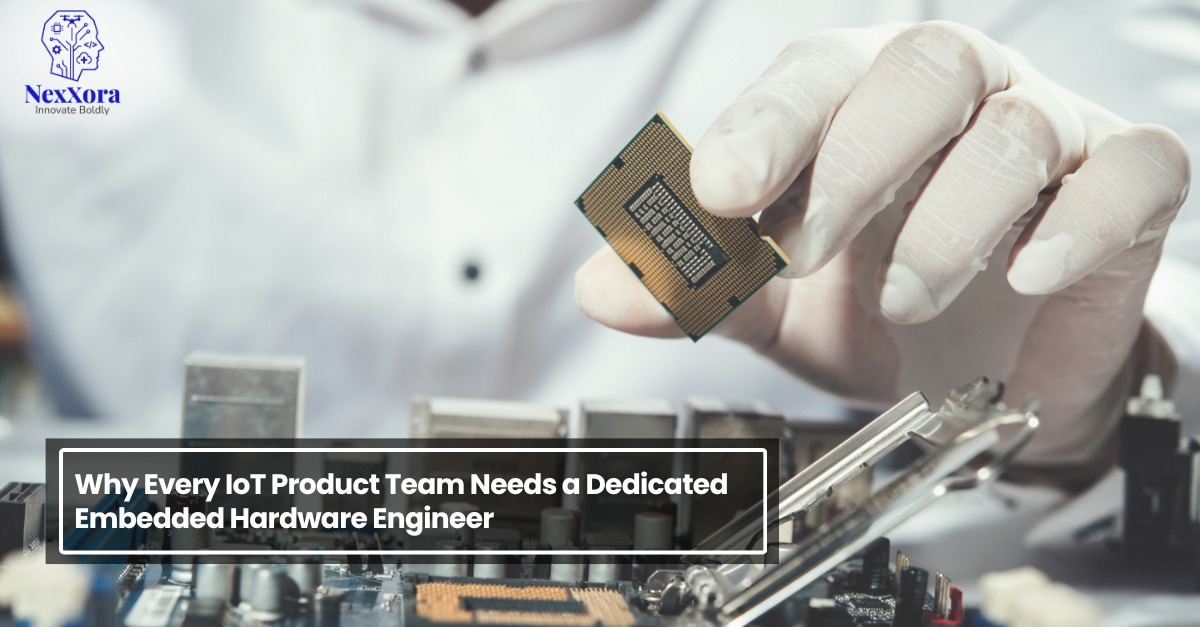
- Understanding the Role of an Embedded Hardware Engineer in IoT
- What Defines Embedded Hardware in Modern IoT Systems
- How Embedded Hardware Engineers Drive IoT Functionality
- Why Every IoT Product Team Needs an Embedded Hardware Engineer
- Collaboration Between Embedded Hardware Engineers and Other Engineering Domains
- Real-World Applications Across Industries
- Common Challenges in Embedded Hardware Development and Expert Solutions
- Impact of Embedded Hardware Engineers on Product Success and Team Efficiency
- Industry Example: Embedded Hardware in Smart Agriculture Solutions
- Frequently Asked Questions
- Final Thoughts
Understanding the Role of an Embedded Hardware Engineer in IoT
The Internet of Things has established itself as a new technological age. The concept exists in modern times, where the number of Internet of Things devices currently active exceeds 18.8 billion and is expected to reach more than 40 billion by the year 2030. Engineers apply fundamental engineering principles to develop all Internet of Things devices, including sensors, industrial gateways, wearables, and edge computing devices. The embedded hardware engineer, especially a hardware design engineer in Chennai, plays a central role in engineering because they develop and test the silicon based components that form the foundation of IoT intelligence systems, while also supporting seamless IoT integration services across connected platforms.
Embedded hardware engineers need to master both analog and digital electronics, along with firmware development, signal integrity, and power distribution network design functionalities. Project deliverables include creating schematics, optimizing PCB designs, selecting hardware components such as MCUs, FPGAs, and SoCs, and performing both hardware and software testing. This skill set is critical for any IoT device company, as it helps detect system defects early in the development phase, issues that would otherwise cost up to 10 times more to fix later, while ensuring efficient and reliable IoT integration services throughout the product lifecycle.
What Defines Embedded Hardware in Modern IoT Systems
The current Internet of Things architecture structure operates through three architectural levels that create its three-layered system. The fundamental operation of computing systems depends on physical hardware components which provide the necessary foundation for all other technologies used from cloud computing to MQTT broker servers and edge artificial intelligence systems. The embedded hardware in IoT systems consists of multiple subsystems which manufacturers must design to achieve seamless operation between all components.
- Microcontroller Units (MCUs) and System-on-Chip (SoC) platforms range from ultra-low power-consuming Cortex-M microcontrollers to Cortex-A processors.
- The wireless communication stacks include IEEE 802.15.4 and BLE 5.x and Wi-Fi 6 (802.11ax) and LoRaWAN and NB-IoT and LTE-M technologies.
- The battery-powered edge nodes require power management ICs (PMICs) and energy harvesting circuits.
- The interface circuits with sensors include I²C and SPI and UART and CAN Bus and Modbus RTU and AFEs.
- The security hardware uses Trusted Platform Modules (TPMs) and ARM Trust Zones and Hardware Root-of-Trust engines.
The embedded hardware engineer needs to develop complex circuitry according to IPC-2221 design guidelines and RoHS compliance and FCC/CE regulations.
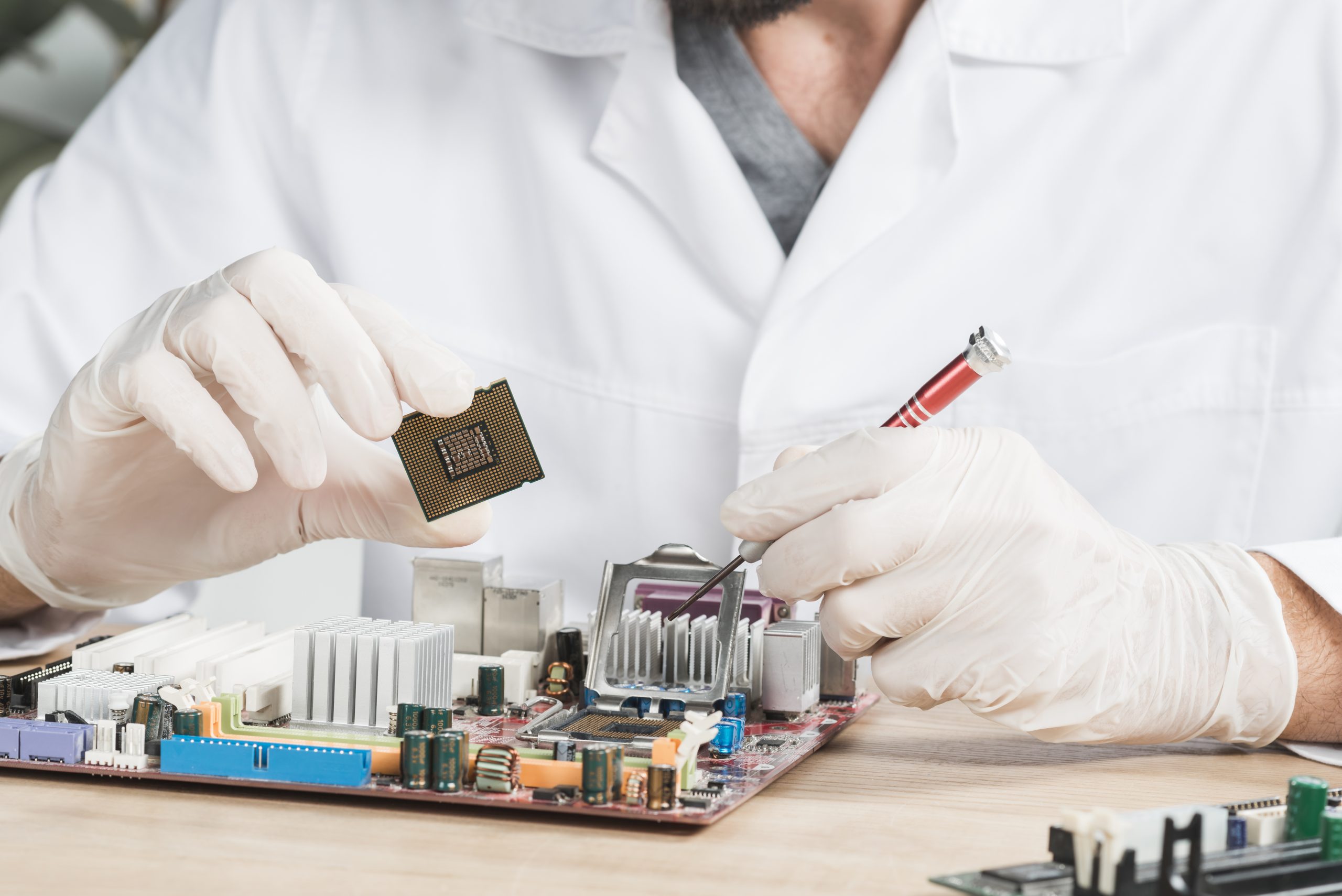
How Embedded Hardware Engineers Drive IoT Functionality
An expert embedded hardware engineer creates scalable and manufacturable (DFM/DFA) and dependable platforms for their field work beyond their ability to follow signals and analyze datasheets. The development work enables IoT products to achieve their operational lifespan which lasts between five to ten years while establishing their complete product lifecycle and total cost of ownership (TCO) calculation. The key responsibilities include:
- The hardware-software interface design needs to match MCUs’ peripheral components with firmware ISRs and RTOS task requirements
- The company needs to conduct pre-compliance EMI/EMC simulations through industry-standard EDA software before starting physical implementation.
- The thermal analysis process requires junction-to-ambient thermal resistance (Theta Ja) calculation and heatsink design and creation of copper pours which protect hot nodes.
- The team creates DFT features which enable debugging through boundary scanning and In-Circuit Test (ICT) with pogo pin fixtures.
- The team establishes multiple benefits through their work because it reduces the time needed for product development and decreases NPI duration which helps businesses achieve their market entry goals while increasing their profits through fast product release.
Why Every IoT Product Team Needs an Embedded Hardware Engineer
Product teams that choose to outsource their embedded hardware engineering work or to disregard this specialized field will experience three common problems which include silicon level errata that occurs during layout and impedance mismatch which leads to RF desensitization and power sequencing problems which cause flash memory corruption during field operation. The dedicated embedded hardware engineer solves all existing issues through complete control of the hardware design review process which includes all development stages from initial design to design validation testing. The product industry studies show that teams which implement dedicated hardware engineers for their hardware engineering tasks can achieve a 37% reduction in PCB re-spin rates and a 22% decrease in their total certification duration. The failure of wireless radios for IoT devices to meet FCC Part 15 and CE RED (Radio Equipment Directive) certifications will result in product launch delays which range from three to six months and incur retest expenses between $50,000 and $200,000. The dedicated embedded hardware engineer will handle all pre-compliance work during development instead of treating it as a secondary task.
Collaboration Between Embedded Hardware Engineers and Other Engineering Domains
The process of delivering an IoT device requires expertise from multiple fields. The hardware engineer of an IoT product functions as the technical link between the firmware team and the mechanical team and the cloud team and the quality control team. The hardware engineer develops documentation that explains board support package implementation through memory maps and register maps which enable firmware developers to create HAL drivers without confusion. The locations of connectors and the PCB shape and exposed thermal pads must conform to enclosure specifications and IP rating requirements of the IoT node for IP67 protection. The selection of hardware components establishes the memory capacity and cryptography capabilities and flash partitioning for OTA updates which decide which applications can be operated on the edge.
Real-World Applications Across Industries
The influence of the embedded hardware engineer extends almost everywhere within any connected vertical space. For IIoT, they create robust gateway boards that function from −40°C to +85°C while offering MIL-STD-810 vibration tolerance. For smart building applications, they develop multi-protocol sensor nodes with Modbus RTU, BACnet/IP, and DALI lighting control all on one embedded system. For medical IoT, they deal with the EMC standards set out by the IEC 60601-1-2 and hardware documentation for FDA 510(k). For consumer wearables, they ensure sleep-mode power draw is less than 10µA.
Common Challenges in Embedded Hardware Development and Expert Solutions
Even experienced teams encounter embedded hardware challenges that can stall IoT programs:
- Component obsolescence: With global semiconductor lead times stretching from 26–52 weeks after 2022 supply chain problems, an embedded hardware engineer builds for second sourcing of components and compatible pins from the start.
- Radio Frequency Interference: BLE, Wi-Fi, and Zigbee communication sharing the same printed circuit board demands judicious placement of antennas, RF shields, and software arbitration such as the Packet Traffic Arbitration (PTA).
- Security flaws: Physical Unclonable Functions (PUFs), signed firmware images for a secure boot chain, and JTAG locking form part of the protection strategy to guard field deployed nodes against physical threats.
Impact of Embedded Hardware Engineers on Product Success and Team Efficiency
The ROI from hiring an embedded hardware engineer can be quantified. Savings from fewer PCB iterations amount to $15,000 to $80,000 per iteration, depending on board complexity. More rapid DVT completion helps get products to market faster. Less frequent product returns, which correlate with the quality of hardware design, lower warranty reserve expenses and safeguard brand value. In the 2025 competitive world of IoT, with its ever-decreasing margins, only those companies investing in hardware will come out ahead.
Industry Example: Embedded Hardware in Smart Agriculture Solutions
Think about an IoT application in Precision Agriculture involving 50,000 acre implementation using 8,000 LoRaWAN-based sensors measuring soil moisture. Each sensor is required to run for five years on two AA batteries, survive IP67 conditions, and report back to a server every 15 minutes. In this scenario, the embedded hardware engineer will choose a sub-GHz SoC along with an embedded LoRa transceiver, design a switched-capacitor voltage converter that runs efficiently between AA to 3.3V, and ensure optimal PCB copper pour design for thermal considerations. In essence, five-year-and-two-months battery life at 15-minute reporting can be achieved here.
Frequently Asked Questions
- What does an embedded hardware engineer do in an IoT project?
An embedded hardware engineer designs PCBs, selects MCUs and sensors, and ensures the physical hardware layer is power-efficient, RF-compliant, and manufacturable at scale.
- When should an IoT team hire a dedicated embedded hardware engineer?
From the concept phase. Involving an embedded hardware engineer early prevents costly architectural mistakes and aligns hardware choices with firmware, cloud, and certification requirements before schematic capture begins.
How does embedded hardware engineering affect IoT security?
Hardware engineers implement secure boot, TPM modules, JTAG lockdown, and cryptographic accelerators—security controls that cannot be patched in software if omitted from the hardware design.
- How can Nexxora help IoT teams manage distributed embedded hardware engineers?
Nexxora’s remote employee monitoring platform gives engineering managers real-time visibility into distributed hardware team productivity, sprint delivery, and cross-functional collaboration—without micromanagement. Learn more at nexxora.technology.
- Can Nexxora support teams with on-site and remote embedded hardware engineers?
Yes. Nexxora supports hybrid and fully remote hardware engineering teams, providing unified dashboards for time tracking, deliverable milestones, and productivity analytics across geographies and time zones.
- Does Nexxora integrate with engineering tools used by embedded hardware teams?
Nexxora integrates with Jira, Confluence, GitHub, and project management platforms commonly used by IoT hardware teams, making it easy to connect activity tracking to engineering deliverables.
Final Thoughts
The embedded hardware engineer is no auxiliary position; it is a defining part of the product itself. Given today’s IoT market requirements for efficient power consumption, reliable wireless communication, built-in security, and scalable manufacturing, this specialty becomes the key to success. In light of increasingly complicated IoT implementation scenarios and instability in the global hardware supply chain, the embedded hardware engineer’s importance is only going to rise.
For companies with distributed IoT product development teams composed of hardware engineers, firmware developers, and cloud architecture specialists operating from different locations, ensuring engineering coherence and accountability becomes an additional problem to solve. With platforms like Nexxora, engineering managers get access to the data they need to ensure remote hardware development teams stay productive, accountable, and focused on timely deliveries while retaining the autonomy required for effective technical work.







No comment