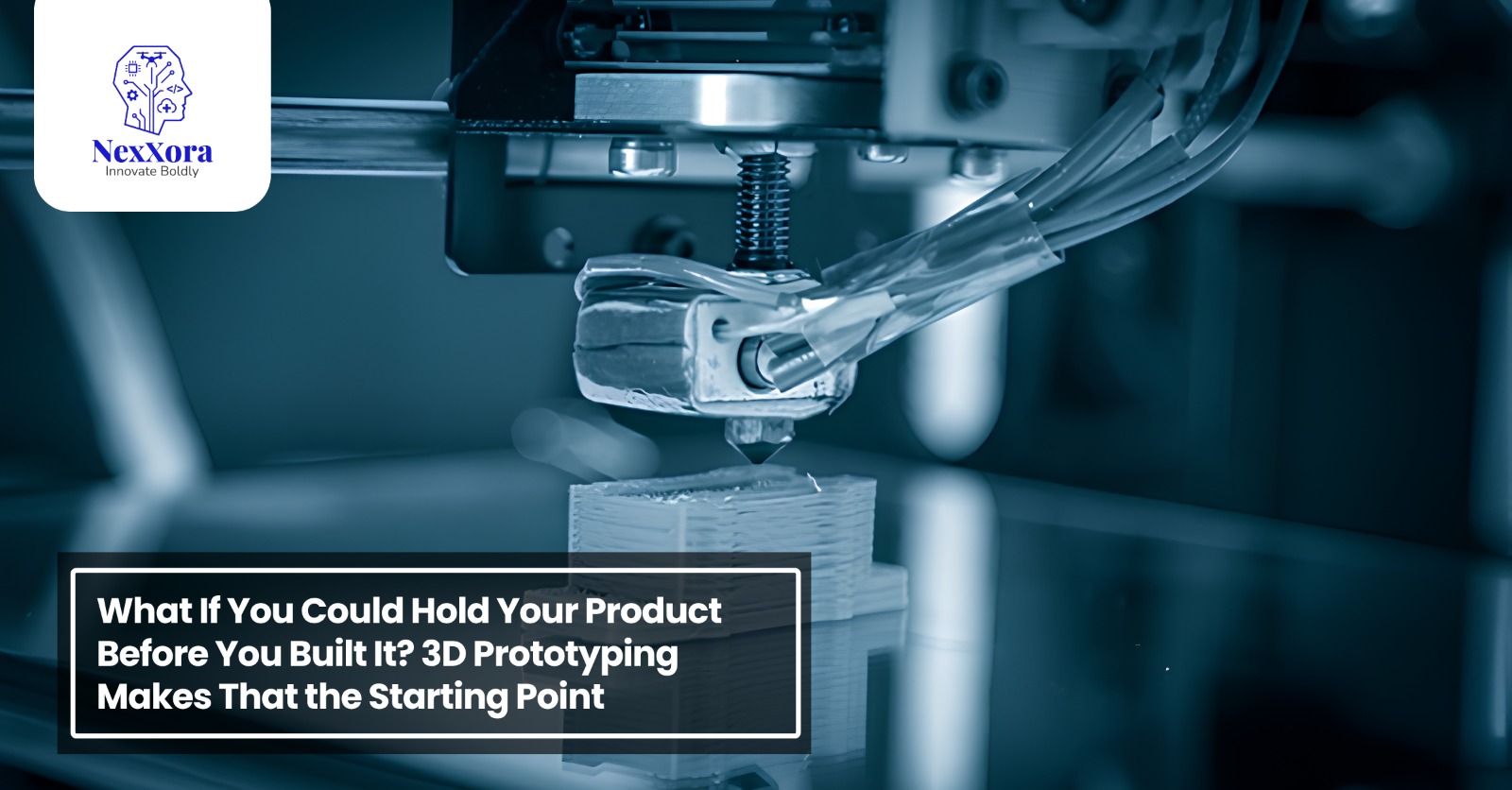
As organizations move towards the dynamic digitalization and automation world, they cannot afford lengthy development phases, costly design errors, and late product launches. Organizations from various sectors are looking for new means to be more innovative, test their ideas, and launch their products more effectively. It is here that 3D prototyping technology is shaping the future of product innovation and development.
What if one could visualize, evaluate, and validate his or her product design even before the actual manufacturing process takes place? Well, it is all possible now thanks to the latest 3D prototyping. It can assist startups in developing their revolutionary products and help enterprises in manufacturing their innovative industrial tools.
At Nexxora Inc. and Nexxora Technology, we provide advanced digital solutions and intelligent manufacturing means to enable organizations to adopt this latest generation of product innovation and development using state-of-the-art 3D prototyping.
- What Is 3D Prototyping?
- Importance of 3D Prototyping in Modern Product Development
- How 3D Prototyping Works
- Industries That Use 3D Prototyping
- The Use of 3D Printing in 3D Prototyping
- Digital Twin Technology and 3D Prototyping
- How AI Is Revolutionizing 3D Prototyping
- Difficulties in Traditional Product Design
- Why Enterprises Are Adopting 3D Prototyping
- Trends to Expect in the Future of 3D Prototyping
- Nexxora – Your Partner in Intelligent Product Innovation
- Why 3D Prototyping Is the Future
- Conclusion
- FAQs
What Is 3D Prototyping?
3D prototyping involves the creation of a physical or digital prototype of a product using sophisticated 3D modeling technologies before the start of manufacturing. The prototypes assist engineers, designers, manufacturers, and other parties involved in understanding the look, function, dimensions, and behavior of a product under different conditions.
In contrast to traditional product development processes, which were highly dependent on drawings and imagination, 3D prototyping enables companies to
- Accurately visualize their products
- Identify errors in designs early
- Facilitate teamwork
- Save on production expenses
- Speed up the time to market
- Test functionality prior to manufacturing
Contemporary 3D prototyping uses techniques such as:
- Computer-Aided Design (CAD)
- 3D printing
- Simulation modeling
- Digital twin technology
- VR visualization of products
- Rapid manufacturing
This innovation is changing industries worldwide.
Importance of 3D Prototyping in Modern Product Development
In the past, the product development process usually required many modifications, which were both expensive and costly to the company. An error in the design that was only identified during the manufacturing process would cost the company a lot financially and also cause delays in production.
Using 3D prototyping helps firms detect problems with their designs early enough and rectify them in time.
Benefits of 3D Prototyping
1.Speed of Production Process
The most important advantage of 3D prototyping is speed, since it enables engineers to develop physical products from designs in mere hours or days.
It helps firms to:
- Be quick to launch new products in the market
- Be one step ahead of competing firms in the industry
- Be responsive to the demands of the market
For most companies operating in automotive, health care, electronics, aerospace, and consumer goods sectors, speed is an important competitive advantage.
2.Cutting on Development Costs
Developing and manufacturing products before testing the designs is an expensive exercise. Using 3D prototyping will help businesses cut down costs incurred from:
- Production mistakes
- Material wastage
- Redesign costs
- Wastage of resources
Businesses can optimize product quality while maintaining budget control.
3.Accurate Product Evaluation
With the use of digital models and prototypes, engineers are able to test all aspects of the product accurately.
Some areas that can be tested include:
- Dimensions
- Strength of the product
- Compatibility of materials
- Fit
- Human factors
This ensures reliability and enhances satisfaction.
4.Effective Interdepartmental Collaboration
Product design requires collaboration among engineering, manufacturing, marketing, sales, and quality assurance departments.
The advantage of 3D prototyping is improved collaboration among teams, as the product can be visualized and analyzed even before it is manufactured.
This leads to:
- Effective decision-making
- Improved communication
- Rapid approvals
- Improved innovation
5.Increased Innovation
One major reason why innovative products do not emerge is due to the reluctance on the part of businesses to venture into unknown territory. 3D prototyping decreases the risks associated with this uncertainty.
Businesses are therefore encouraged to think out of the box and improve their existing products before investing in them.
How 3D Prototyping Works
The 3D prototyping process includes various steps.
Step 1: Concept Creation
The 3D prototyping process begins with ideas and specifications of the product.
Step 2: CAD Designing
In CAD designing, engineers develop a 3D model that depicts all characteristics of the product to be developed.
Models include:
- Product dimensions
- Product material
- Product mechanical aspects
- Product internal structure
CAD modeling systems offer highly precise product designs.
Step 3: Prototyping
Prototyping involves developing a physical copy of the CAD-designed product through methods such as:
- 3D printing
- CNC machining
- Modeling
- Laser cutting
The types of prototypes developed will depend on project specifications, but could be either a functional prototype or a visual prototype.
Step 4: Testing and Evaluation
Once the product prototype is ready, testing will be done to ensure any defects and weaknesses in the design have been identified.
Testing can include:
- Stress testing
- Thermal testing
- Usability testing
- Structural testing
- Simulation of the function of the device
Step 5: Product Improvement
Based on testing results, engineers refine the design and improve the product before manufacturing begins.
This iterative process ensures better product quality and market readiness.
Industries That Use 3D Prototyping
The utilization of 3D prototyping technology is becoming increasingly popular among various industries.
Automotive Industry
In the automotive industry, 3D prototyping is employed in:
- Testing car parts
- Analyzing aerodynamics
- Designing the interiors of automobiles
- Creating electric cars
These practices have shortened the production processes significantly.
Healthcare Industry
Healthcare institutions also take advantage of 3D prototyping in:
- Creating medical devices
- Developing surgical models
- Producing prosthetics
- Creating custom-made implants
It has enhanced health care delivery and medical innovations.
Aerospace Industry
In the aerospace industry, precision and safety are critical factors.
In such instances, 3D prototyping can help in:
- Designing aircraft components
- Assessing lightweight materials
- Simulating structural designs
- Optimizing engines
- Consumer Electronics
Electronics manufacturers utilize prototypes to test:
- Product ergonomics
- Component locations
- Heat dissipation
- Product aesthetics
This improves usability and product performance.
Manufacturing Industry
Manufacturing companies use 3D prototyping for improving:
- Industrial machines
- Automated factory operations
- Robotics
- Manufacturing production lines
This makes the operations efficient.
The Use of 3D Printing in 3D Prototyping
Modern 3D prototyping relies on 3D printing as one of its most important technologies.
With additive manufacturing technology, it is easy to produce detailed prototypes at affordable rates.
Benefits of Using 3D Printing in Prototyping
Fast Manufacturing
It takes hours to manufacture even complicated products.
Design Variations
It is easier to design unique structures impossible with conventional manufacturing methods.
Choice of Materials
3D printing can manufacture prototypes from the following materials:
- Plastics
- Resins
- Metals
- Fibrous carbon materials
- Minimal Waste
Since there is no wastage of materials in 3D printing, it is environmentally friendly.
Digital Twin Technology and 3D Prototyping
Digital twin technology is one of the newest developments in 3D prototyping.
A digital twin refers to a virtual model replicating the behaviors of physical products or systems.
Some of the benefits of combining digital twins with 3D prototyping include:
- Ability to predict product behavior
- Improving operational efficiency
- Simulation of external factors such as temperature
- Enhanced predictive maintenance
This combination is driving smarter engineering and manufacturing solutions.
How AI Is Revolutionizing 3D Prototyping
Artificial Intelligence revolutionizes 3D prototyping.
AI software assists corporations:
- Optimizing design optimization
- Evaluating material properties
- Analyzing structures
- Streamlining simulation
Machine learning can process thousands of designs and suggest the optimal one.
Such innovation drastically increases efficiency.
Difficulties in Traditional Product Design
Prior to contemporary 3D prototyping technology, enterprises faced obstacles:
- Manufacturing inefficiencies
- Slow production processes
- Product visualization limitations
- High costs for design modifications
- Poor team collaboration
Conventional approaches led to delayed product launches and ineffective responses to market dynamics.
3D prototyping resolves these issues with better and quicker product verification.
Why Enterprises Are Adopting 3D Prototyping
Enterprises that adopt 3D prototyping benefit from multiple factors.
Accelerated Innovation Cycles
Corporations can constantly enhance their products through prototypes.
Decreased Market Risks
Prototypes allow enterprises to validate concepts without substantial financial outlays.
Enhanced User Experience
User tests ensure high-quality product design.
Competitive Advantage
Faster product launches create stronger market positioning.
Trends to Expect in the Future of 3D Prototyping
Many trends in the future of 3D prototyping are currently emerging.
AI-Generated Product Design
Artificial intelligence will design products automatically, based on desired performance parameters.
Advanced Material Technologies
Innovative materials will ensure higher durability and sustainability in manufacturing while providing lightweight performance.
Real-Time Collaboration via Cloud Engineering
Engineers from around the globe will collaboratively engineer product prototypes in the cloud.
Virtual and Augmented Reality for Prototyping
Design engineers and clients will interact with the products in the form of virtual prototypes using VR and AR applications.
Sustainable Prototyping Processes
Processes and tools used in prototype manufacturing will ensure the eco-friendliness of operations.
Nexxora – Your Partner in Intelligent Product Innovation
Today, companies need partners who can provide engineering solutions and also offer intelligence in digital innovation to ensure intelligent product innovation.
Nexxora Inc offers businesses intelligent solutions through innovative technology that can help them become more efficient in their engineering processes and innovate effectively.
On the other hand, Nexxora Technology assists businesses in acquiring engineering capabilities, automation strategies, and digital transformations through various advanced technologies.
Integration of technologies like:
- AI engineering
- Digital transformation
- Intelligent automation
- Data-driven manufacturing
- Product development
Nexxora helps businesses improve operational efficiency and innovation capabilities.
Why 3D Prototyping Is the Future
The world is advancing towards speed, intelligence, and sustainability in product development processes. Companies using only traditional approaches will probably find themselves behind competitors who have adopted a more digital approach.
Here are some reasons why 3D prototyping is a smarter solution because it helps organizations:
- Develop better products
- Reduce risks associated with product development
- Increase innovation velocity
- Facilitate collaboration between departments
- Provide better customer experiences
From machinery to medical equipment to electronics to consumer goods, 3D prototyping is an indispensable component of any modern engineering process.
Conclusion
The possibility of having the final result of your work in hand before starting production is not something to dream about anymore—this opportunity has become a necessary competitive advantage for companies around the world.
Advanced prototyping technologies allow organizations to develop better solutions faster and smarter.
Adopting the digital engineering approach is the key to success for industries undergoing change and transformation nowadays.
FAQs
1. What is 3D prototyping?
3D prototyping is the process of creating digital or physical product models before final manufacturing to test functionality, design, and performance.
2. Why is 3D prototyping important?
3D prototyping helps businesses reduce costs, accelerate product development, improve accuracy, and minimize manufacturing risks.
3. Which industries use 3D prototyping?
Industries such as automotive, healthcare, aerospace, electronics, manufacturing, and consumer products widely use 3D prototyping.
4. How does 3D printing support prototyping?
3D printing enables the rapid creation of physical prototypes using digital models, allowing faster testing and design validation.
5. What are the benefits of 3D prototyping?
Major benefits include:
- Faster product development
- Reduced costs
- Better design accuracy
- Improved innovation
- Enhanced collaboration
6. Can startups use 3D prototyping?
Yes. Startups benefit greatly from 3D prototyping because it allows affordable testing and faster product validation before large-scale investment.
7. What technologies are used in 3D prototyping?
Common technologies include:
- CAD software
- 3D printing
- Digital twins
- AI simulation
- CNC machining
8. How does AI improve 3D prototyping?
AI helps optimize designs, automate simulations, predict performance issues, and improve engineering efficiency.
9. Is 3D prototyping cost-effective?
Yes. It reduces manufacturing errors, material waste, and redesign costs, making product development more efficient.
10. What is the future of 3D prototyping?
The future includes AI-driven design, immersive virtual testing, sustainable manufacturing, and advanced material innovation.






No comment