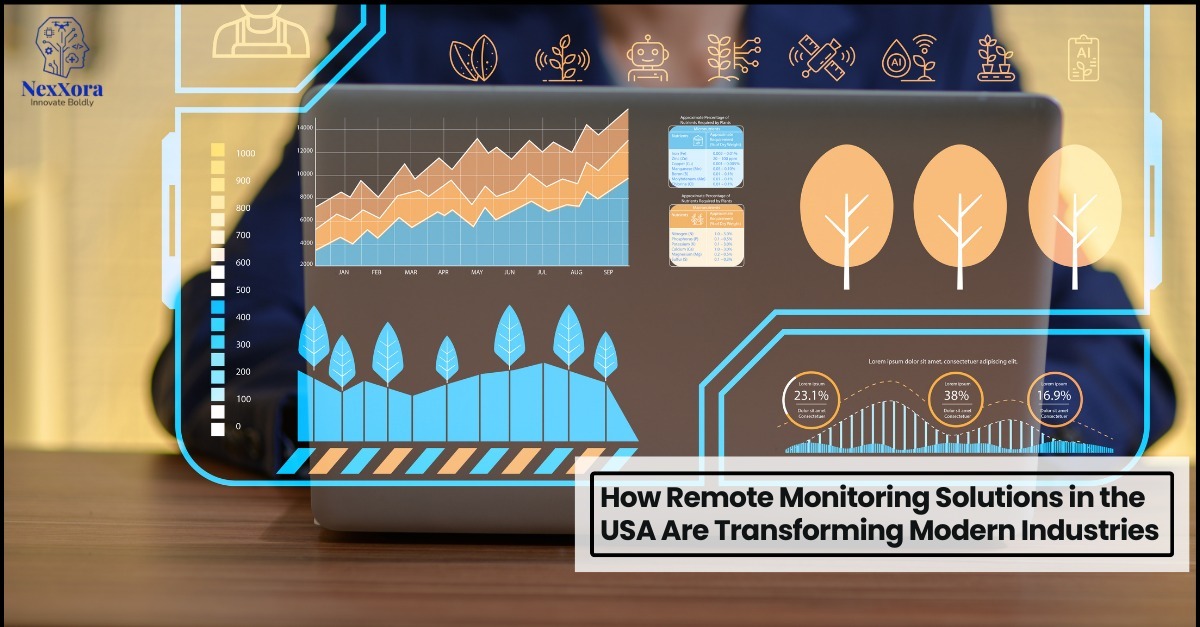
The need for a trustworthy remote monitoring solution has never been more pressing in the United States. From factories to hospitals, businesses today rely on a smart remote monitoring solution to monitor assets, avoid downtime, and reduce costs – in real-time. As the digital transformation of every industry continues to gain momentum, selecting the most suitable remote monitoring solution has become a key strategic imperative rather than a mere technical consideration.
- The Rising Need for Remote Monitoring Solutions in the USA
- Downtime and Equipment Failure Challenges
- Limited Multi-Site Operational Visibility
- Compliance and Regulatory Monitoring Requirements in the USA
- Cybersecurity Issues in Remote Monitoring Systems
- Lowering Operational and Maintenance Expenses with Automation
- Industry Use Cases of Remote Monitoring Solutions in the USA
- Integration with IOT and Smart Infrastructure
- How to Choose the Right Remote Monitoring Solution Provider in the USA
- Emerging Trends in Remote Monitoring Technology
- Frequently Asked Questions (FAQs)
- Conclusion
The Rising Need for Remote Monitoring Solutions in the USA
Today, American businesses are heavily investing in advanced remote monitoring solutions in USA to improve operational visibility, enhance security, and drive data-driven decision-making across industries. The U.S. remote monitoring and management market is expanding at a CAGR of over 11% and is not expected to slow down anytime soon. Three factors are primarily fueling this rapid growth: the sheer number of IoT devices, the need for lean operations, and the emergence of remote workforces that cannot be effectively monitored from an on-site perspective.
A smart remote monitoring solution integrates cloud technology, AI analytics, and wireless sensors to provide real-time visibility into any setting – from a data centre in Texas to a pipeline in Alaska or a hospital wing in New York. Businesses that implement an effective remote monitoring solution today gain a measurable edge in efficiency, safety, and compliance.
Downtime and Equipment Failure Challenges
Unplanned downtime is estimated to cost U.S. manufacturers billions annually. A dedicated remote monitoring system directly tackles this issue by providing predictive maintenance capabilities, detecting warning signs before they become catastrophic and costly failures.
Using an effective system, sensors are constantly streaming temperature, vibration, and pressure readings. When these readings go out of range, the remote monitoring system automatically triggers alerts, allowing maintenance personnel to address issues before equipment failures occur. Essential features include:
- Early warning detection: Continuous sensor streaming alerts to anomalies the moment they occur.
- Automatic escalation: Alerts are immediately directed to the appropriate technician through a centralised dashboard.
- Historical trend analysis: Long-term data analysis shows patterns that predict future failures.
- Remote analysis: Engineers analyse issues from headquarters, minimising costly on-site visits.
Limited Multi-Site Operational Visibility
Having dozens, or even hundreds, of sites to manage without a centralized remote monitoring platform creates perilous blind spots. Data remains isolated, reaction times are slow, and discrepancies arise. A centralised remote monitoring platform eliminates this problem by aggregating all site data into a single view, allowing for cross-site comparisons and informed decision-making.
Whether it’s 200 retail locations or 50 utility substations, the proper remote monitoring platform provides geospatial mapping, role-based access control, and customizable KPI views to transform operational mayhem into actionable intelligence.
Compliance and Regulatory Monitoring Requirements in the USA
U.S. regulations require constant monitoring in countless sectors. A compliant remote monitoring platform enables organizations to meet the EPA, FDA, HIPAA, NERC CIP, and OSHA requirements simultaneously, all while automatically producing audit-ready reports.
For instance, industrial facilities are required by the EPA to meet emissions regulations through Continuous Emissions Monitoring Systems (CEMS). A suitable remote monitoring platform can be the foundation of a CEMS system, collecting and reporting data in a form acceptable to regulatory authorities. A healthcare-oriented remote monitoring platform, on the other hand, ensures that patient information transmitted through remote monitoring systems complies with HIPAA privacy rules at every point.
Cybersecurity Issues in Remote Monitoring Systems
Each connected remote monitoring system increases the attack surface for an organisation. Ransomware attacks on water treatment plants and energy companies have shown that an inadequately protected remote monitoring system can bring critical infrastructure down. Cybersecurity must be integrated into every remote monitoring system from the start, rather than as an afterthought.
When considering platforms, check the following cybersecurity requirements:
- End-to-end encryption: All data in transit and at rest must be completely encrypted by the platform.
- Multi-factor authentication (MFA): All user access points must implement MFA.
- Network segmentation: Monitoring systems should be isolated from the rest of the corporate network to contain damage.
- NIST Cybersecurity Framework compliance: The remote monitoring system vendor must comply with federal guidelines.
Lowering Operational and Maintenance Expenses with Automation
The economic engine within every successful remote monitoring system is automation. By replacing manual observation with continuous automated data collection, a remote monitoring system reduces personnel expenses while simultaneously improving coverage and accuracy.
Studies show that predictive maintenance enabled by a remote monitoring solution reduces maintenance costs by 10–25% versus scheduled maintenance, and up to 50% versus reactive repairs. Energy optimization features embedded in a smart remote monitoring solution can trim utility bills by 15–30% in commercial facilities, delivering ROI that typically outpaces initial investment within the first year.
Industry Use Cases of Remote Monitoring Solutions in the USA
A good remote monitoring solution has applications in almost all U.S. industries:
- Healthcare: Remote patient monitoring solutions monitor patients’ vital signs from the comfort of their homes, thus preventing readmissions.
- Manufacturing: IoT-based remote monitoring solutions make smart manufacturing possible.
- Energy & Utilities: A remote monitoring solution assists power companies in managing their energy grids, ensuring that they are within set regulations.
- Commercial Real Estate: A remote monitoring solution assists facilities managers in controlling building systems like HVAC, lighting, and security for an entire portfolio of buildings.
- Transportation & Logistics: Telematics and temperature control are classic uses of a remote monitoring solution.
Integration with IOT and Smart Infrastructure
The best remote monitoring solution platforms are based on open IOT platforms that integrate seamlessly with existing infrastructure. Whether a facility has Modbus PLCs, OPC-UA SCADA systems, or cloud APIs, a robust platform integrates without the expense of rip and replace upgrades.
The edge computing capabilities of a top remote monitoring solution enable the processing of data locally, lowering latency and bandwidth expenses, and 5G connectivity enables real-time control for time-sensitive applications. Digital twin functionality allows users to model the behaviour of assets, enabling more intelligent preventive maintenance before issues occur in the real world.
How to Choose the Right Remote Monitoring Solution Provider in the USA
Choosing a remote monitoring solution provider is an investment for the long term. Here is a checklist to assess potential providers:
- Industry experience: Has the remote monitoring solution provider successfully implemented solutions in your industry?
- Scalability: Can the remote monitoring solution scale from 10 sensors to 10,000 without changing the platform?
Integration depth: Will the remote monitoring solution integrate with your ERP, CMMS, and BI systems through open APIs?
- Security posture: Is the remote monitoring solution SOC 2 or ISO 27001 compliant?
- Support SLAs: What are the uptime guarantees provided by the remote monitoring solution provider?
- Total cost of ownership: Consider hardware, licensing, implementation, and scaling costs over a 3-year period.
Emerging Trends in Remote Monitoring Technology
The future of remote monitoring solution technology is being defined by four emerging trends:
- AI & Machine Learning: Predictive analytics in a remote monitoring solution go beyond rule-based notifications to self-sustaining anomaly detection.
- 5G Connectivity: Low-latency 5G connectivity makes a remote monitoring solution suitable for real-time control of mission-critical processes.
- Augmented Reality: AR-enabled remote monitoring solution platforms enable field technicians to access expert advice superimposed on real-world equipment.
- Autonomous Drones: Sensor-laden unmanned platforms can expand the scope of any remote monitoring solution to dangerous or hard-to-reach areas.
Frequently Asked Questions (FAQs)
What is a remote monitoring solution?
A remote monitoring solution is a technology solution that gathers real-time data from physical assets or environments and provides that data to operators anywhere in the world, allowing for faster decision-making, reduced site visits, and predictive maintenance.
Which industries benefit most from a remote monitoring solution in the USA?
The healthcare, manufacturing, energy, logistics, and commercial real estate industries realize the most value from a remote monitoring solution, but any industry with geographically distributed assets or strict regulatory requirements will greatly benefit.
How secure is a remote monitoring solution?
The level of security provided by a remote monitoring solution depends on the vendor. A good remote monitoring solution will employ end-to-end encryption, MFA, and network segmentation and will be aligned with the NIST Cybersecurity Framework. It is essential to audit the vendor’s security certifications prior to implementation.
What does a remote monitoring solution cost?
Cloud-based remote monitoring solution platforms can begin at a few hundred dollars per month for small-scale deployments. Enterprise-scale deployments can easily cost six figures per year. A comprehensive total cost of ownership analysis should include hardware, software, integration, and support costs.
Conclusion
A reliable remote employee monitoring solution has become not only a desirable but a necessary tool for growing businesses. By providing a scalable, secure, and real-time intelligent solution for employee monitoring, Nexxora Technology’s Remote Employee Monitoring Software enables organizations to efficiently and effectively manage their remote workforce. With the evolution of AI-driven analytics and automation, organisations that implement a reliable and future-ready solution today will be better poised to lead in performance, accountability, and digital transformation.




No comment