With each passing day, modern enterprises work in an increasingly complex environment, with thousands of machines, assets, and systems generating mountains of data every second. And that’s the challenge to make that data meaningful. A powerful industrial monitoring platform, supported by remote monitoring and management software, ensures centralized control, real-time visibility, and deep analytics that enable organizations to optimize their operations, assure uptime, and drive noticeable performance improvements.
This whitepaper discusses how one integrated industrial monitoring solution, enabled through remote monitoring and management software, provides manufacturing operations monitoring, smart factory visibility, and machine data analytics to help track production performance and stay competitive in today’s data-driven environment.
- Centralized Command: The Power of One Platform
- From Raw Signals to Smart Operations
- Key Features of a Modern Industrial Monitoring Platform
- Industry Applications: Where the Platform Drives Impact
- Deployment Considerations for Maximum ROI
- Real-World Impact: Proof in Action
- Conclusion: Nexxora’s Industrial Monitoring Platform Drives Operational Excellence
- FAQs: Answering Your Industrial Monitoring Questions
Centralized Command: The Power of One Platform
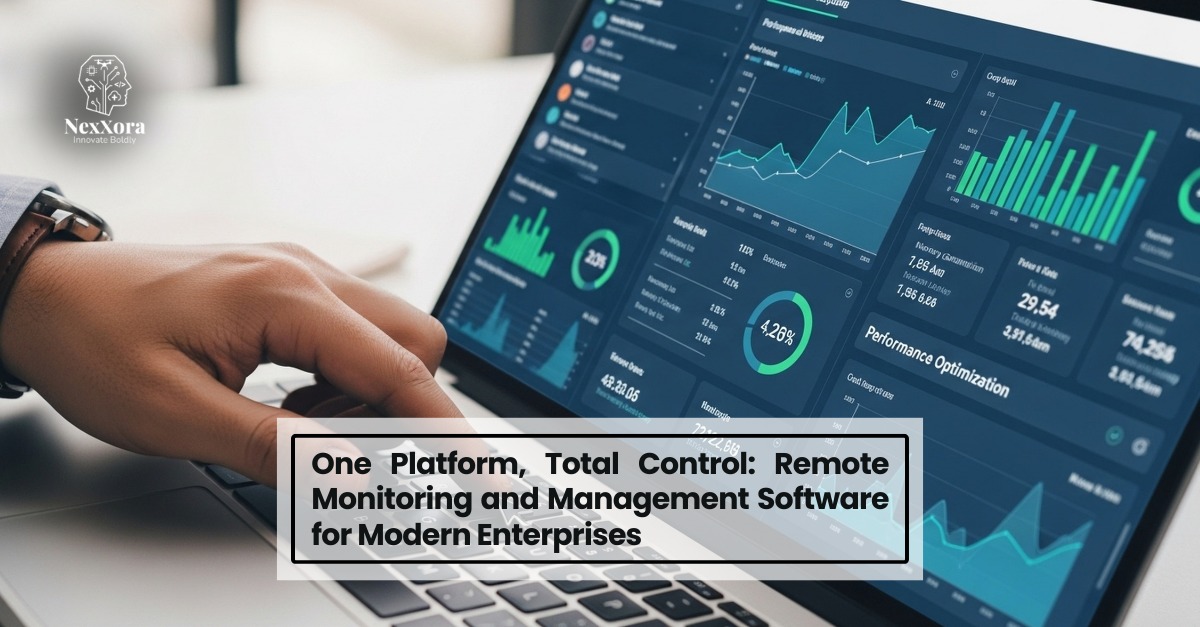
“One Platform, Total Control” enables a unified monitoring platform for all business operations. Instead of using different tools for machines, assets, analytics, and alerts, businesses will be able to leverage real-time information, utilize advanced machine data analytics, and unlock key insights on a single secure platform.
This integrated control layer helps make seamless manufacturing operations monitoring, full visibility in the smart factory, and accurate production performance measurement possible. This helps in identifying problems and optimizing operations.
From Raw Signals to Smart Operations
Remote monitoring transcends monitoring possibilities of equipment status and utilizes IoT technology for monitoring and obtaining continuous, synchronous, and real-time data from geographically dispersed assets on a 24×7 cycle. IoT technology-integrated sensors and nodes enable high resolution for capturing telemetry data such as temperature, vibration, electric current, energy consumption, and status variables.
The collected data is communicated to edge gateway nodes through industrial communication protocols, where data processing, filtering, and data normalization are initially conducted. The processed data is further transmitted to cloud platforms, where data mapping, description, and learning are carried out.
This is made possible by integrating IoT technology into remote monitoring, and organizations are able to remotely monitor and control their assets, moving from a repair-focused process to a data-driven operational approach by monitoring and controlling assets condition-based.
Key Features of a Modern Industrial Monitoring Platform
Continuous Operations Monitoring for Maximum Uptime
The contemporary industrial monitoring system enables the real-time viewing of the manufacturing process to give a constant vigilance facility to the operation teams. Additionally, the real-time alert function of the industrial monitoring system enables the easy identification of any irregularity in the process.
Smart Factory Visibility: Insight at a Glance
IOT Integrated dashboards offer real-time views of machine status, energy usage, and performance data. Visibility into the smart factory enables the insights necessary for engineers, operation managers, and executives to make more informed decisions from anywhere, either on-site or off-site.
Predictive Intelligence with Machine Data Analytics
Machine Data Analysis involves detecting concealed trends and inefficiencies that exist in the machinery and processes. Analyzing the historical and real-time values, this system enables predictions for maintenance, maximized use of assets, and process improvements, thereby converting operational data into business values.
Production Performance Tracking: From Metrics to Action
This is in regard to monitoring output, efficiency, availability, and quality on machines and production lines. This ensures the operations of the plant align with the strategic plan. The monitoring of the production performance enables improvement at all organizational levels.
Scalable and Integrable Architecture
The latest industrial monitoring systems are designed for scale and for use in a wide range of industrial environments. These systems also support different industry protocols and work perfectly with ERP, MES, and CMMS systems.
Industry Applications: Where the Platform Drives Impact
Manufacturing and Industrial Operations – End-to-end manufacturing process monitoring helps to enhance the reliability and quality of the equipment as well as the manufacturing throughput
Energy & Utilities – Energy optimization, monitoring load changes, predictive maintenance.
Logistics & Distributed Assets– Fleet management and remote asset tracking centralized enables effective usage and service delivery.
Facilities & Infrastructure – The continuous monitoring of HVAC, power backup, and environment systems enables prompt actions.
Deployment Considerations for Maximum ROI
Successful deployment is affected by:
- Connectivity and Network Reliability for Remote/Hostile Locations
- Big Data accuracy and calibration for reliable insight
- Integration with legacy systems for seamless operations
- Smart alerting for prioritizing significant events
Real-World Impact: Proof in Action
- A production plant was able to decrease its rate of unplanned downtime by 30 percent overall.
- Multi-site logistics companies optimized their use of fleets and reduced operating expenses through centralized asset visibility.
- Energy-intensive plants ensured optimal load management, thereby reducing costs.
These examples illustrate the benefits gained through machine data analysis and the monitoring of productions.
Conclusion: Nexxora’s Industrial Monitoring Platform Drives Operational Excellence
A contemporary industrial monitoring system provides an integrated operational view, smart manufacturing visibility, and advanced machine analytics to optimize business performance. Real-time monitoring, predictive analytics, and manufacturing performance analytics offer the ability to manage operational performance proactively.
In manufacturing floors and distributed networks, Nexxora lends assurance that no signal is going unnoticed, no KPI is left untracked, and no operational decision is made without data. An investment in Nexxora turns operations’ complexity into an intelligence asset: Providing tangible results in an interconnected world.
FAQs: Answering Your Industrial Monitoring Questions
What is an industrial monitoring platform?
It’s a centralized system that collects, analyzes, and visualizes real-time data from machines and assets to support operations monitoring, predictive maintenance, and performance optimization.
How does machine data analytics help manufacturing operations?
It detects patterns, anomalies, and trends in operational data, enabling proactive maintenance, reduced downtime, and improved production efficiency.
Can this platform integrate with legacy machines?
Yes, modern industrial monitoring platforms are designed to integrate with legacy equipment using sensors, gateways, or standard industrial protocols.
How does production performance tracking work?
The platform monitors output, efficiency, uptime, and quality metrics across machines and lines, providing actionable insights to improve operations.
What industries benefit the most from smart factory visibility?
Manufacturing, energy, logistics, and facility management industries, especially organizations with multiple sites or distributed assets, benefit the most.


No comment