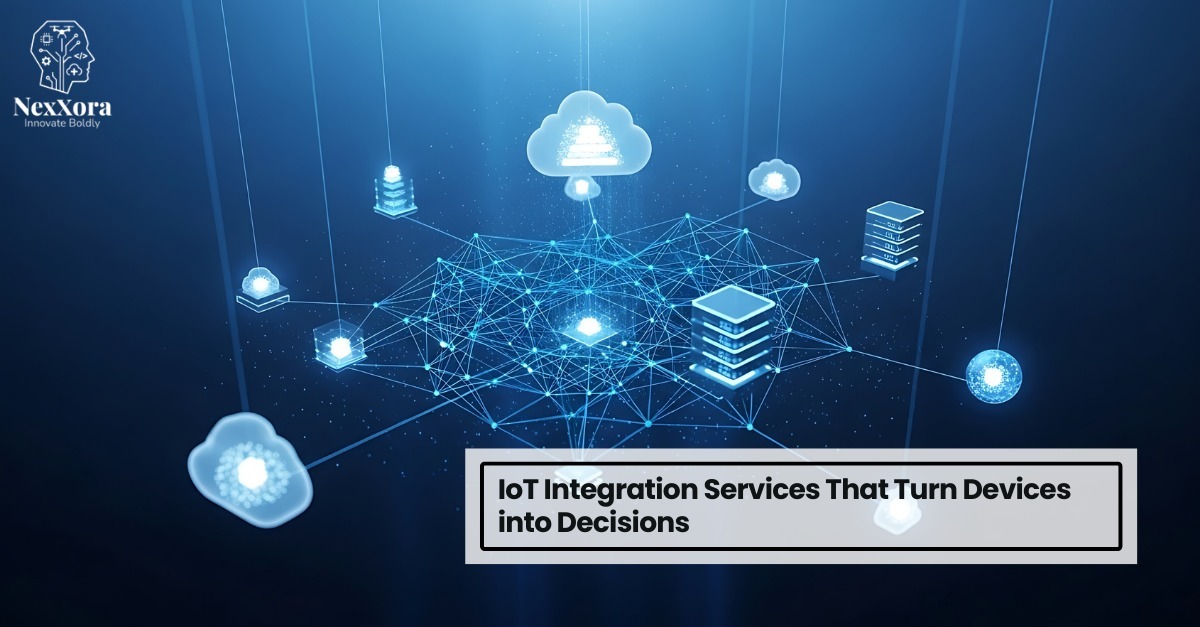
The modern enterprise is quickly embracing the use of IoT to digitize business operations, track assets, and optimize performance. The challenge, however, is not just in connecting devices. IoT data integration plays a critical role in consolidating data streams generated by various sensors, edge devices, and platforms into a unified operational intelligence layer. Effective IoT data integration ensures seamless data flow, interoperability between systems, and real-time analytics, enabling organizations to transform raw device data into actionable business insights.By leveraging IoT integration services, organizations can further optimize sensor data processing, extract actionable connected device insights, and build resilient industrial IoT architecture through effective integration frameworks.
- Understanding IoT Integration and Data Flow
- Why Integrated IoT Systems Are Essential Today
- Business Value of Integrated IoT Data
- How IoT Data Integration Works in Real Environments
- Industry Applications of Integrated IoT Solutions
- Technologies Enabling Modern IoT Integration
- Challenges in IoT Integration
- Best Practices for Successful IoT Integration
- Emerging Trends in IoT and Intelligent Automation
- Actionable Approaches to Adoption of IoT Integration
- Strategic Use of IoT Integration in Digital Transformation
- Frequently Asked Questions (FAQs)
- Conclusion
Understanding IoT Integration and Data Flow
IoT integration can be defined as the systematic integration of data flow between IoT devices, edge gateways, cloud infrastructure, and enterprise systems. This is done to ensure proper ingestion, transformation, and routing of telemetry data that is produced in a distributed manner.
IoT integration, unlike traditional device integration, provides support for protocol transformation, schema harmonization, time-series synchronization, and event-based data processing.
Why Integrated IoT Systems Are Essential Today
Managing Distributed Connected Environments
As IoT deployments scale, enterprises must handle high-frequency data streams, multiple communication protocols, and geographically distributed devices. Integration platforms act as a central control plane that abstracts device heterogeneity and eliminates data silos.
Enabling Real-Time Connected Device Insights
The ability to perform streaming analytics and low-latency processing makes it possible for organizations to have insights into connected devices in near-real-time. This is crucial for monitoring the health of assets, identifying anomalies, and reacting to operational events in an instant.
Business Value of Integrated IoT Data
Optimized Sensor Data Processing
Raw telemetry data is often noisy, incomplete, or inconsistent. Integration layers perform data filtering, aggregation, normalization, and contextual enrichment to improve data reliability and analytical accuracy.
Powering Data-Driven Automation
When integrated data feeds rule engines and AI models, systems can autonomously execute actions such as alerts, configuration changes, or maintenance triggers—forming the foundation for data-driven automation.
Scalable Industrial IoT Architecture
A modular industrial IoT architecture combines edge computing, cloud services, and microservices-based integration layers to support scalability, fault tolerance, and long-term maintainability.
How IoT Data Integration Works in Real Environments
Device Connectivity and Protocol Abstraction
IoT gateways and middleware enable the abstraction of device-level communication protocols such as MQTT, CoAP, OPC-UA, and HTTP to standardized data streams.
Sensor Data Processing and Normalization
Data is validated, timestamped, and enriched with metadata to structured formats suitable for analytics, dashboards, and storage systems.
Enterprise Integration and Automation
IoT data is integrated with ERP, MES, CMMS, and analytics platforms to provide end-to-end operational visibility and decision execution.
Typical integration flow includes:
- Secure device data ingestion
- Edge-level preprocessing and aggregation
- Cloud-based analytics and storage
- Enterprise system synchronization
- Automated alerts and workflows
Industry Applications of Integrated IoT Solutions
Manufacturing and Industrial Operations
IoT integration enables predictive maintenance, real-time equipment monitoring, and process optimization through continuous telemetry.
Healthcare and Medical Monitoring
IoT integration enables the streaming of patient data from connected medical devices into integrated platforms for remote monitoring, compliance, and analytics.
Retail, Logistics, and Supply Chain
IoT integration enables inventory accuracy, cold chain monitoring, and logistics optimization through real-time sensor visibility.
Technologies Enabling Modern IoT Integration
Edge and Cloud Computing
Edge computing allows for low-latency processing of data close to devices, while cloud platforms offer centralized analytics and storage.
Middleware, APIs, and Integration Platforms
Integration middleware provides abstraction of hardware and enables secure and scalable data transfer between devices and applications.
Advanced Analytics and AI
Machine learning algorithms analyze integrated data to produce predictive insights and optimize system performance.
Challenges in IoT Integration
Interoperability and Legacy Systems
Handling various devices and legacy systems demands adaptable integration platforms and common data structures.
Security and Data Governance
End-to-end encryption, identity services, and access management are necessary to secure data in an integrated IoT ecosystem.
Best Practices for Successful IoT Integration
To ensure long-term success, the following practices should be adopted:
- Operational and automation goals should be defined
- A layered industrial IoT architecture should be designed
- Data models and schemas should be standardized
- Security should be embedded throughout the data pipeline
- Pilot projects should be initiated and scaled up
Emerging Trends in IoT and Intelligent Automation
AI-Enabled Edge Intelligence
Analytics are being increasingly deployed at the edge, allowing for faster insights and less dependence on the cloud.
Unified Platforms for Connected Device Insights
Companies are integrating connectivity, analytics, and automation capabilities into unified platforms to simplify complexity.
Digital Twins and Predictive Operations
Digital twins of physical assets allow for simulation, forecasting, and optimization based on real-time data.
Actionable Approaches to Adoption of IoT Integration
For successful adoption, there is a need to integrate technology with business objectives. Organizations should focus on observability, monitoring, and integration infrastructure investments, as well as promoting IT and business collaboration.
Strategic Use of IoT Integration in Digital Transformation
IoT integration platforms connect operational technology and business intelligence to optimize and innovate continuously.
Frequently Asked Questions (FAQs)
Q1. What is IoT data integration?
A. IoT data integration is the process of collecting, unifying, and managing data from multiple IoT devices and platforms in a single system.
Q2. Why is IoT data integration important for modern businesses?
A. It helps businesses convert raw IoT data into actionable intelligence, operational visibility, and automation.
Q3. How does IoT data integration improve connected device insights?
A. It enables real-time data flow and analytics, allowing organizations to monitor device performance and behavior accurately.
Q4. What is the role of sensor data processing in IoT systems?
A. Sensor data processing cleans, normalizes, and structures raw sensor data so it can be analyzed efficiently.
Q5. How does industrial IoT architecture support scalability?
A. Industrial IoT architecture uses modular layers such as edge, cloud, and middleware to scale devices and data securely.
Q6. Can IoT data integration enable data-driven automation?
A. Yes, integrated IoT data allows systems to automatically trigger actions based on real-time conditions and analytics.
Q7. Which industries benefit most from IoT data integration?
A. Manufacturing, healthcare, logistics, retail, energy, and utilities benefit significantly from integrated IoT systems.
Q8. Is IoT data integration secure?
A. It is secure when implemented with encryption, identity management, and proper data governance controls.
Q9. What are the common challenges in IoT data integration?
A. Device interoperability, data silos, security risks, and performance scalability are common challenges.
Q10. Can IoT data integration grow with business expansion?
A. Yes, a well-designed industrial IoT architecture supports seamless expansion as connected devices increase.
Conclusion
Nexxora offers professional IoT integration services that help businesses leverage the power of connected device data, optimize sensor data processing, and develop scalable industrial IoT architecture. Through a partnership with Nexxora, businesses can turn IoT data into actionable intelligence that fuels innovation, efficiency, and growth. With Nexxora, your IoT environment becomes smarter, faster, and future-ready.transform raw IoT data into actionable intelligence, driving innovation, efficiency, and business growth.


No comment