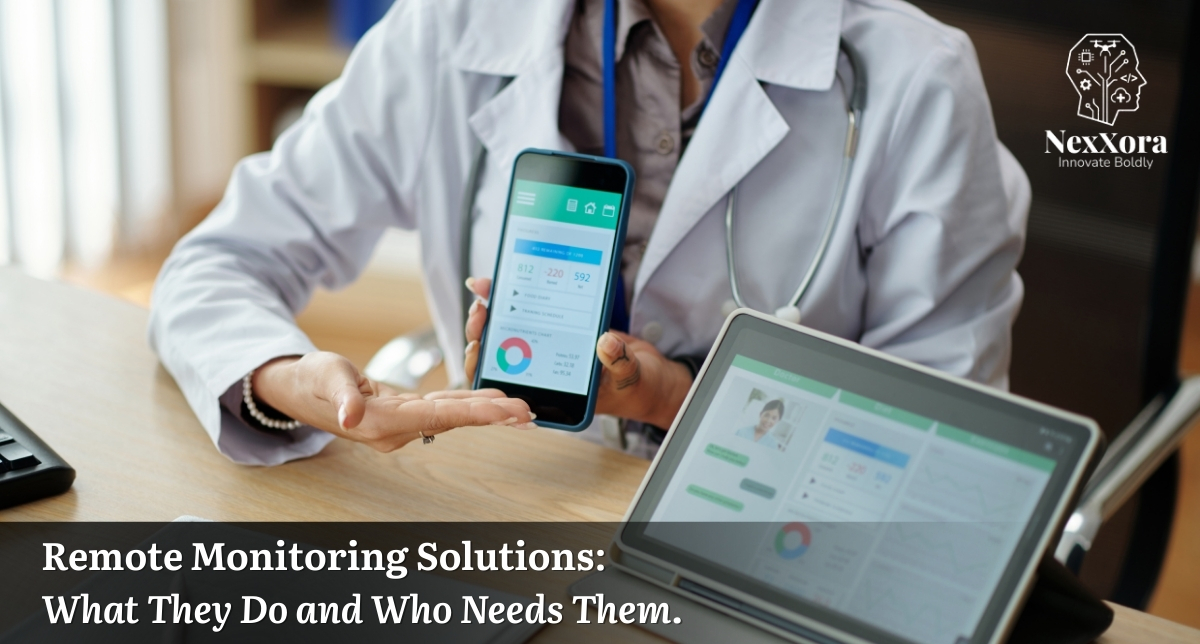
This blog provides an answer to the question many business decision-makers have, which is: “What does remote Monitoring Solutions do?”
This Resource gives a straightforward explanation of what Remote Monitoring Solutions does, provides a few examples to illustrate its capabilities, and shows how remote Monitoring Solutions fits into today’s business environment.
What is Remote Monitoring Solutions?
Remote Monitoring Solutions is an all-encompassing digital solution that enables individuals to stay on top of their equipment’s status, performance, and location in real time, from anywhere. Remote Monitoring Solutions collects current condition data from Internet of Things (IoT) Monitoring Devices and stores it in the cloud for visualisation via intuitive dashboards and graphics, enabling teams to take action to prevent equipment failure.
Essentially, you gain the ability to see, hear, and be alerted to every piece of equipment managed by you around the world on a 24 hr / 7-day basis.
How Remote Monitoring Works?
- Using sensors to collect real-time data on devices, including:
- Voltage, current, power
- Temperature, vibration, pressure
- GPS location
- Energy and fuel consumed
- Hours of operation
- Environmental conditions
Every asset emits its health signal via a sensor that collects data; the foundation of IoT monitoring is the ability to convert previously used equipment into smart equipment by simply adding a sensor to it.
2. The Cloud Receives Telemetry Solutions’ Data
Telemetry refers to the transmission of any form of measurement across long distances.
There are several ways to send data, including:
- Wi-Fi
- 4G/5G
- LoRaWAN
- NB-IoT
- Ethernet
These methods provide a fast and dependable means of transmitting data. They can also convey data from locations that are far away from one another, such as factories located in remote areas and trucks traveling at high speeds.
3. Dashboards in the Cloud – Turning Data into Insights
Here’s where the miracle lies!
Via Cloud Operations Monitoring Platforms, the overwhelming amount of data collected and transmitted as live data that is created from the Internet of Things (IoT) becomes easily interpreted as follows:
- Visual data displays (graphs)
- Trends
- Threshold Alerts
- Asset Performance History
- Predictive Data
No longer do asset management teams have to guess at what is going on with an IoT-enabled asset – they now know what’s happening to the asset in real-time!
4. Dashboards enable Operations Leadership to:
- Detect Anomalies
- Uptime Monitoring
- Asset Comparison & Performance
- Make Data-Driven Decisions
- Schedule Timely Maintenance
Offer of immediate notice and automated responses to assigned entities by: Intelligent monitoring systems;
Examples of notifications include:
- Machine overheating,
- Motor pulling erratic current,
- Generator fuel indicator dropping below levels necessary for operation,
- Transformer voltage spiking up and down,
- Refrigerators exceeding the threshold temperature,
- Vehicle traveling down the wrong path.
- Notification ensures all issues are accounted for.
In addition to notifying users, some systems will also automatically perform actions such as:
 Activate backup systems,
- Decrease load on equipment,
- Send commands to devices based upon pre-determined parameters,
- Document all activity to maintain compliance.
Remote Monitoring Services Capabilities
It is possible to monitor virtually anything, and the most prevalent examples include:
- Equipment Monitoring: Machine, Motor, Compressor, CNC, Pump Systems, HVAC, Gensets, Stabilizers
- Asset Tracking: Fleet Vehicles, Containers, Tools, Rental Equipment, Construction Machinery
- Monitoring Power and Energy: Voltage Fluctuations, Power Factor Harmonics, Consumption Analytics
- Environmental Monitors: Temperature, Humidity, Air Quality, Water Levels
- Process Monitors: Production Line, Inventory Conditions, Flow Rates.
Anything that moves, uses electricity, creates something, and is prone to failures can be monitored.
Industries That Benefit The Most
The Remote Monitoring Solutions Is A Transformation Tool across Every Industry.
1. Manufacturing And Factory Operations
- Thanks To the Predictive History Of Machine Failure
- Reduced Downtime By Predictive Maintenance
- Tracking Key Performance Indicators for Production
- Enhanced Maintenance Planning
2. Energy And Utility
- Monitoring Of Transformers And Substations, Solar Farms
- Real Time Power Quality Monitoring
- Reduced Outage And Stress On Equipment
3. Logistics And Fleet
- Live GPS Tracking Of Vehicles
- Fuel Consumption Monitoring
- Adherence To Routes
- Driver Behaviour Analytics
4. Construction And Mining
- Asset Tracking For Location
- Monitoring Of Equipment Health
- Reduced Theft And Misuse
5. Health Care
- Remote Monitoring Of Equipment Condition
- Cold Chain Monitoring For Vaccines
- Tracker For Generators And Power Backup System
6. IT And Data Centre
- Monitoring Server Temperature And Load
- Real-Time Notifications Of Failures
- Increased Uptime And Compliance With SLAs
7. Facility Management
- Monitoring Of HVAC System
- Monitoring Of AMC Service Records
- Automated Scheduling For Maintenance
The IoT Monitoring And Real-Time Dashboard Can Provide Immediate Value To Any Entity That Operates With Critical Assets.
Remote Monitoring Is Now an Absolute Necessity
The business world of today faces a slew of challenges.
There are:
- Increasing Maintenance Costs
- Increased Risk of Downtime
- Diminishing Numbers of Technical Employees
- More Complex Distributed Systems
- Higher Competition
- Increasingly Strict Compliance Activities
Remote Monitoring Addresses These Issues and Creates Predictable, Preventive, Digital, Automated, and Transparent Operations.
Most importantly, it removes the guesswork from the equation.
NexXora provides solutions for remote monitoring that go beyond simply collecting data; instead, they provide actionable information.
The Solutions Provided by NexXora Include:
- Dashboards – Dashboard displays provide a real-time view of all information in one location, giving the user a quick and clear understanding of everything happening in the field.
- Predictive Alerts – Predictive alerts enable you to prevent problems or failures before they occur.
- Integration of Multiple Devices (IoT) – You will be able to integrate multiple devices, including industrial equipment (machines & tools), and see the information from all of the devices at once
- Asset Tracking and Geofencing – With Asset Tracking and Geofencing, you can see the assets’ locations and conditions and track their movements.
- Scalable Telemetry – They design these telemetry solutions for use in factories or large companies and to be used in multiple locations.
- Customized Automation Workflows – Automate actions based on insights taken from these solutions.
What does this mean? Smarter operations, safer assets, and reduced maintenance costs.
Remote Monitoring Is The Future Of Operations
As we advance to Industry 5.0, the use of Remote Monitoring Solutions (RMS) is key to enabling businesses to run reliably and with minimal downtime. RMS provides businesses with an overview of their operations, allowing them to take action sooner and enabling them to base their decisions on data. It eliminates guesswork from the equation.
From tracking machines and fleets to tracking power systems and critical assets, RMS allows businesses to move from a reactive approach to a predictive one.
FAQs
- What does remote monitoring do?
Remote Monitoring allows you to follow up with the status of any machines or other property from wherever you are not located at the time.
With Remote Monitoring –
- Identify Breakdowns Before They Occur
- Avoid Stopping Production
- Keep Everything Safe for Employees
- Eliminate Manual Inspection
- Save Money on Maintenance
- Make Decisions Based on Real-time Facts
- How does remote Monitoring Solutions work?
Real-time viewing comes from connecting all the Technology and Cloud Dashboards with Internet of Things Devices.
How does it work?
1 – Data is collected by sensors that measure things like temperature, voltage, vibration, and GPS.
2 – Data is transferred through different types of wireless networks: Wi-Fi, 4G/5G, LoRa, and Ethernet.
3- The data is processed on a Cloud Server using threshold analytics.
4- The Information collected is displayed on Dashboards as insights using graphs, alerts, and status updates.
5- Whenever a sensor collects data that falls below or exceeds a pre-defined safe limit, an alert will be sent to the user.
6- Once the user receives the alert, it will be their responsibility to respond, or, if the system is automated, the system will respond automatically.
- What exactly are RM services?
Tech and industrial companies offer RM Services (Remote Monitoring Services) to track client assets, equipment, and/or processes remotely.
At a high level, RM Services include:
- Installation of devices and sensors
- 24/7 monitoring of data
- Automated alerts and notifications
- Predictive maintenance assistance
- Reports on performance
- Remote troubleshooting assistance
- Access to the cloud dashboard
- Analytics of past data
- What does RMM Solutions do?
RMM Solutions is generally an IT team or service provider’s tool for managing and monitoring their IT assets remotely. By using RMM Solutions, IT support staff can manage all their devices remotely with little or no physical access. The primary purpose of an RMM is to ensure that IT systems are maintained securely, updated, and properly functioning without needing to directly access each device.


No comment