
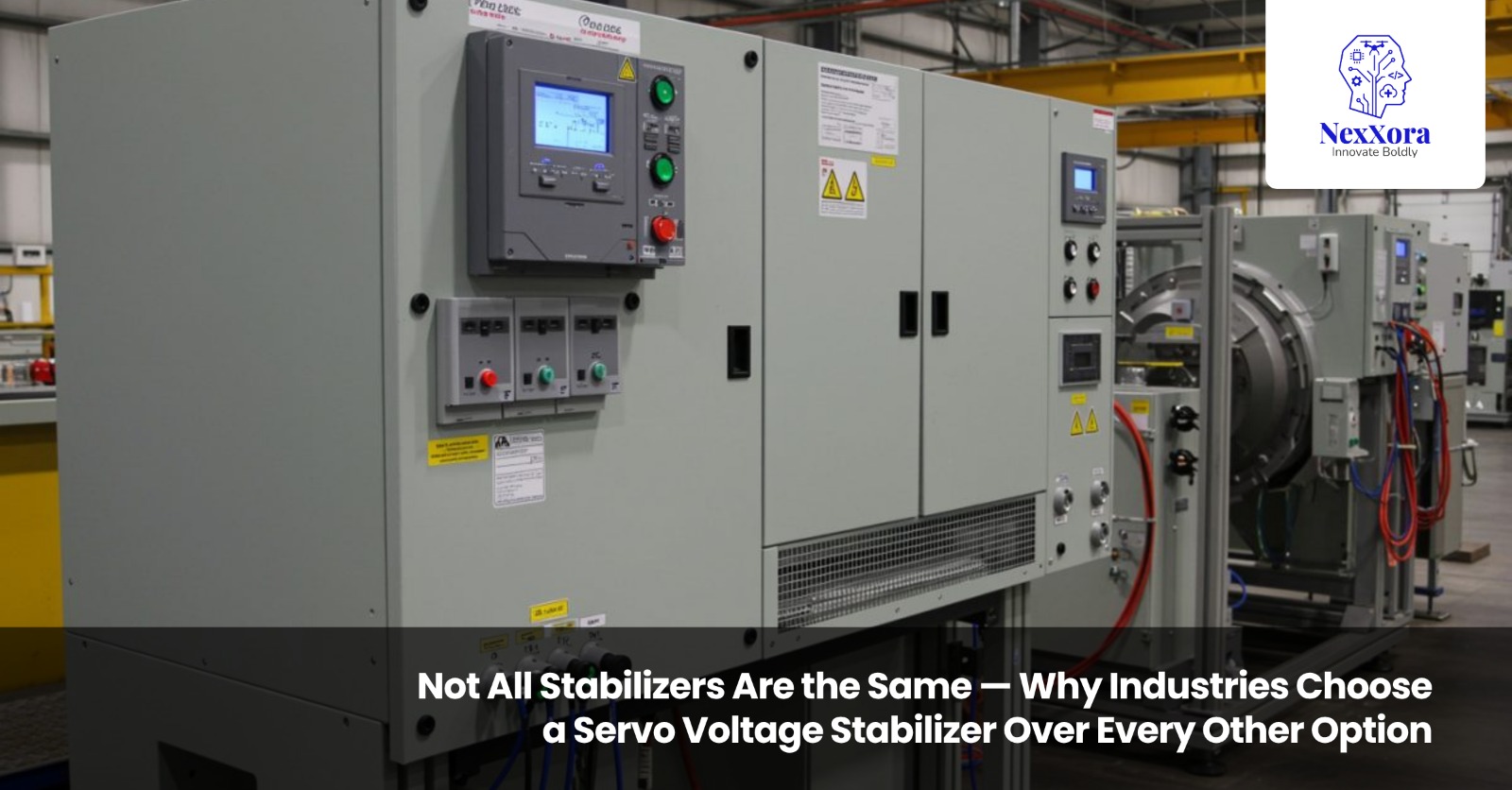
In the current industrial scenario, uninterrupted and constant flow of power is extremely important for efficiency. In factories, CNC machines, healthcare facilities, IT systems, and more, most of the modern-day industries depend on sensitive electrical equipment which requires constant voltages to ensure their efficient functioning.
However, among the major issues that industries face in places such as India, voltage fluctuations is one of the largest problems. Overvoltage as well as undervoltage leads to damage to equipment and affects production, reduces efficiency, and increases cost of maintenance.
And that is why it makes sense that industries use the servo voltage stabilizer instead of conventional voltage correction systems.
Unlike regular stabilizers, servo stabilizers provide precise voltage regulation, better efficiency, faster response times, and also offer greater protection to industrial equipment. For those who care about operational continuity, efficiency, and reliable functioning, servo voltage stabilizers cannot be missed out.
In this blog post, let us explore why industries are opting for the servo voltage stabilizer, its benefits, working, applications, and how technological companies like Nexxora help in optimizing industrial power and energy-efficient infrastructure solutions.
- Problems Related to Voltage Fluctuations in Industries
- Problems Associated with Voltage Fluctuations
- What Is a Servo Voltage Stabilizer?
- Working Mechanism of Servo Voltage Stabilizer
- Reasons Why Industries Favor Servo Voltage Stabilizers
- Servo Voltage Stabilizer vs Conventional Stabilizers
- Commonly Utilized by These Industries
- Features Modern Industries Seek from Servo Stabilizers
- The Increasing Need for Smart Electric Infrastructure
- The Future of Voltage Stabilization Technology
- Closing Words
- FAQs
Problems Related to Voltage Fluctuations in Industries
Industries need huge amounts of power every day. Large machinery, automation systems, robots, air conditioners, and other equipment require stable voltage.
But what causes voltage fluctuations?
- Grid instability
- Sudden variations in loads
- Transformer faults
- Distribution problems
- High load during peak hours
- Faulty electrical system
- Transmitting power over long distances
The effects of such fluctuations can have a devastating impact on the equipment.
Problems Associated with Voltage Fluctuations
Equipment Malfunction
Equipment will not operate correctly due to over-voltage and under-voltage situations.
Manufacturing Process Interruption
Any kind of electrical failure will stop the whole production process.
Shorter Life Span of Equipment
Fluctuating voltage leads to higher stress on the equipment.
Increased Power Consumption
Voltage instabilities cause low efficiency.
System and Data Loss
In case of voltage fluctuations, IT systems and automation might not work properly.
For operations that run around the clock, just a few minutes of downtime might mean significant losses for any industry.
What Is a Servo Voltage Stabilizer?
A servo voltage stabilizer is an advanced voltage correction system that provides stable voltage despite the variation in the input voltage source.
It contains:
- Servo motors
- Buck-boost transformer
- Circuitry
- Voltage sensor
Unlike conventional stabilizers, servo stabilizers provide highly accurate voltage correction with minimal delay. Many modern systems achieve voltage accuracy within ±1%.
Working Mechanism of Servo Voltage Stabilizer
Automatic voltage detection and correction are how servo voltage stabilizers operate.
Step One: Voltage Monitoring
Servo stabilizers constantly monitor the voltages.
Step Two: Voltage Fluctuation Detection
Once voltage becomes higher or lower than what the system wants, the control system senses any change.
Step Three: Servo Motor
The servo motor adjusts the position of the variable transformer.
Step Four: Voltage Correction
Buck-boost transformers either increase or decrease voltage.
Step Five: Stable Output Supply
Connected electrical devices can continue operating because the stabilizer provides a constant supply of voltage.
It is a continuous process that helps in uninterrupted operations of industrial systems.
Reasons Why Industries Favor Servo Voltage Stabilizers
All stabilizers do not have equal uses in industry. Some stabilizers are good enough to use in homes but industries need something more than just stabilizers.
Here are some reasons why industries prefer using servo voltage stabilizers over other types of voltage stabilizers.
1.Voltage Accuracy
One thing about servo voltage stabilizers is their accuracy. Many of the industrial-quality stabilizers feature:
- Voltage accuracy to ±1%
- Continuous voltage correction
- Constant power output
It means such stabilizers play an important role in various fields of technology. For instance, CNC machines, robotics, automation devices, medical appliances, and semiconductors.
- Safeguarding Costly Equipment
The repairs and replacement cost for industrial machinery is astronomical.
Fluctuations in voltage may lead to damages in:
- Machines
- Plc systems
- Drives
- Compressors
- Process controllers
- Electronic boards
The servo voltage stabilizer plays an important role in protecting such investment by providing safe voltage supply.
- Increased Efficiency
Efficiency is one of the top considerations for most businesses due to escalating electricity costs.
In order to increase efficiency through the use of servo stabilizers:
Reduce unnecessary power losses due to voltage fluctuations
Avoid excessive energy consumption
Ensure maximum efficiency on electrical loads
Some industrial systems have recorded up to 98% efficiency levels.
These result in:
- Low energy costs
- Lower operational expenses
- Increased sustainability
- Shorter Reaction Times
Industrial activities require instant correction during fluctuations in voltage.
Most servo stabilizers offer:
- Fast reaction times
- Constant monitoring
- Immediate voltage regulation
They operate at correction speeds that are only fractions of a second long.
This reduces chances of:
- System shut down
- Disruption in production
- Wide Input Voltage Variations
There are always fluctuating voltages in industrial activities.
Most servo voltage stabilizers work within input voltage range of:
- 140V to 270V (single phase)
- 300V to 500V (three phase)
This makes them suitable for areas with unstable grid conditions.
- Long Working Lifetime
Industrial servo stabilizers have been made with an objective of operating in the long term.
These benefits are enjoyed by users due to:
- Copper-coiled transformer
- Strong design
- Minimal maintenance
- Long working lifetime
Some products have been constructed to run effectively for 15-20 years.
- Increased Productivity
Power plays a critical role in ensuring productivity in industries.
Benefits of servo stabilizers include:
- Reduced system shutdowns
- Machine failure reduction
- Consistent manufacturing processes
- Quality assurance
Industries having uninterrupted power sources encounter less downtime.
Servo Voltage Stabilizer vs Conventional Stabilizers
Let’s compare the differences clearly.
Feature | Servo Voltage Stabilizer | Conventional Stabilizer |
Voltage Accuracy | Very High (±1%) | Moderate |
Response Speed | Fast | Slower |
Industrial Suitability | Excellent | Limited |
Efficiency | High | Moderate |
Maintenance | Low | Moderate |
Voltage Correction | Continuous | Basic |
Equipment Protection | Advanced | Limited |
Lifespan | Long | Moderate |
This is why industries rarely depend on ordinary stabilizers for mission-critical operations.
Commonly Utilized by These Industries
The use of servo voltage stabilizers is common in industries that have precise electrical systems.
Manufacturing Facilities
Application for:
- CNC machinery
- Robotic systems
- Production lines
- Automation processes
- Medical Industry/Hospitals
Provides protection for:
- MRI systems
- CT scanners
- Medical diagnosis devices
- ICU systems
- IT/Data centers
Serves:
- Server farms
- Networking systems
- Data storage facilities
- Cloud computing networks
- Printing and packaging industries
Provides stable voltage for:
- Printing machinery
- Labeling equipment
- Packaging machinery
- Textile industry
Provides protection to:
- Weaving machines
- Dyeing machinery
- Automatic textile machinery
- Telecommunication infrastructure
Guarantees continuous performance for:
- Communication towers
- Network hardware
- Broadcasting equipment
Most manufacturers identify such industries as key users of servo stabilizers.
Features Modern Industries Seek from Servo Stabilizers
In modern industries, features like:
Digitally Monitored
Live voltage reading and diagnostics.
Automated Monitoring
Integration with automation devices used in industries.
Remotely Monitored
Devices using IoT to monitor the device.
Overload Protection
It safeguards the device against voltage surge.
Thermal Protection
Helps in avoiding device overheating.
Phase Protection
Ensures the protection of the three-phase system from any damage.
The Increasing Need for Smart Electric Infrastructure
Nowadays, modern industries have started considering intelligent electrical systems that include the use of:
- AI
- IoT
- Smart automation
- Predictive maintenance
- Cloud-based monitoring
Management of power is not only about regulating the voltage anymore. Nowadays, it has become all about:
- Optimizing energy consumption
- Using data analytics in maintenance activities
- Monitoring in real time
- Grid integration
This is where technology-driven companies play a major role.
Today’s industrial operations need more from electrical systems than in previous decades. They demand scalable, intelligent, and energy-efficient infrastructures.
Businesses receive the support of advanced digital transformation, automation, and infrastructure optimization solutions from Nexxora Inc. tailored for modern industrial settings.
On the other hand, Nexxora Technology offers engineering-driven industrial electrical systems, machine power optimization, energy-efficient infrastructure solutions, and smart operational technologies to industries searching for reliable and high-performing solutions.
Expertise in industrial electrical systems from Nexxora covers:
- Machine power optimization
- Energy efficiency solutions
- Predictive maintenance practices
- Operational continuity solutions
- Smart infrastructure solutions
Their engineering services for industries are oriented toward reliability improvement, minimal downtime, and optimal energy use in industrial facilities.
The Future of Voltage Stabilization Technology
Voltage stabilization technology is evolving and becoming smarter.
New advances in voltage stabilization include:
AI-Based Voltage Regulation
Using artificial intelligence for predictive correction and load balancing.
IoT-Based Voltage Stabilization
Connected to the cloud stabilizer for remote diagnostics.
Smart Energy Usage Analysis
Real-time analysis of power usage and optimization.
Green/Environmentally Friendly Electrical Infrastructure
Systems aimed at minimizing electrical waste.
Predictive Electrical Maintenance
Machine learning-based system to predict electrical issues.
By integrating those technologies, industries can achieve a competitive edge in their fields.
Closing Words
Unstable power supply cannot be tolerated by any industry.
Though voltage fluctuations may seem insignificant, their effects on equipment, efficiency, costs, and continuity of business operations can prove disastrous for industries.
This is one reason why an industry will always prefer a servo voltage stabilizer over other types of voltage stabilizers. This is because a servo voltage stabilizer has numerous advantages that are listed below.
- Accuracy in voltage regulation
- Better protection to machines
- Higher energy efficiency
- Quick action
- Minimal downtime
- Reliability in operations
As industries adopt automation, artificial intelligence (AI), and smart technologies, managing voltages efficiently becomes increasingly important.
FAQs
1. What is a servo voltage stabilizer?
A servo voltage stabilizer is an automatic voltage correction system that maintains stable output voltage despite fluctuations in input power supply.
2. Why is a servo voltage stabilizer important for industries?
Industries use servo stabilizers to protect sensitive equipment, reduce downtime, improve energy efficiency, and maintain stable operations.
3. How accurate is a servo voltage stabilizer?
Most industrial servo stabilizers provide voltage accuracy within ±1%.
4. What industries use servo stabilizers?
Industries such as manufacturing, healthcare, telecom, textile, IT, printing, and automation commonly use servo voltage stabilizers.
5. How does a servo stabilizer improve energy efficiency?
It reduces power losses caused by voltage fluctuations and ensures equipment operates at optimal voltage levels.
6. What is the lifespan of a servo voltage stabilizer?
Industrial servo stabilizers can operate efficiently for 15–20 years with proper maintenance.
7. Can servo stabilizers handle large voltage fluctuations?
Yes. Many systems support wide voltage ranges such as 140V–270V for single-phase and 300V–500V for three-phase systems.
8. Are servo stabilizers suitable for CNC machines?
Yes. Servo stabilizers are widely used for CNC machines because they require highly stable voltage for precision operation.
9. What is the difference between a servo stabilizer and a normal stabilizer?
Servo stabilizers provide faster response, higher voltage accuracy, better efficiency, and superior industrial protection compared to conventional stabilizers.
10. Can servo stabilizers integrate with smart industrial systems?
Yes. Modern servo stabilizers support IoT monitoring, smart automation, predictive maintenance, and remote diagnostics for intelligent industrial infrastructure.




No comment