
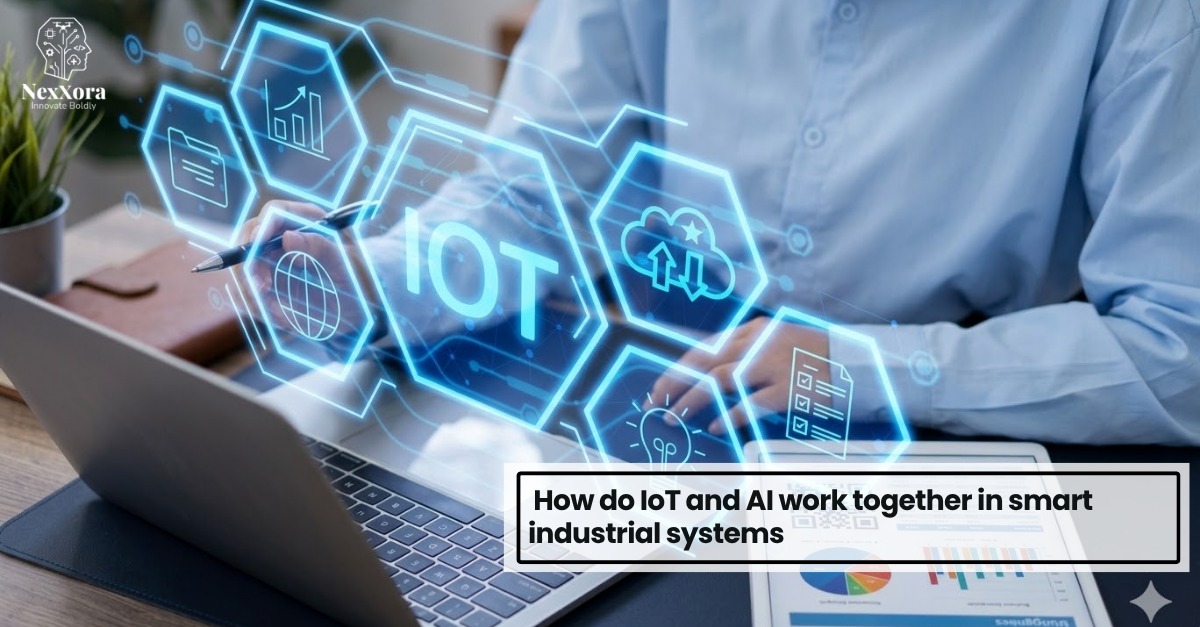
The convergence of AI IoT technology has redefined how industrial facilities operate at their core level. As manufacturers strive to achieve Industry 4.0, the integration of physical devices with intelligent algorithms has become no longer an advantage but rather a necessity. This guide aims to simplify how AI IoT technology works in smart industrial facilities and why it matters in the manufacturing world, particularly through the growing role of IoT integration services that help connect devices, data platforms, and automation systems seamlessly.
- What Is AI IoT and Why It Matters in Manufacturing
- Role of IoT Devices in Smart Industrial Environments
- How Artificial Intelligence Enhances IoT Data Processing
- How AI IoT Works Together in Smart Industrial Systems
- Key Technologies Behind AI IoT Integration
- Industrial Applications of AI IoT in Manufacturing
- Benefits of AI IoT for Smart Industrial Operations
- Challenges in Implementing AI IoT in Industrial Systems
- Future Trends of AI IoT in Smart Manufacturing
- FAQ
- Conclusion
What Is AI IoT and Why It Matters in Manufacturing
AI IoT—the combination of artificial intelligence and the Internet of Things—is the network of connected physical devices that collect real-time data, which is then analyzed by AI to make decisions. In the manufacturing industry, it enables machines to self-diagnose, self-optimize, and self-correct.
In the absence of AI, IoT is just noise. And in the absence of IoT, AI is blind to the real world. AI IoT is an intelligent system that can directly enhance yield, safety, and efficiency.
Role of IoT Devices in Smart Industrial Environments
IoT devices serve as the sensory nervous system of a smart factory. These include:
- Edge sensors monitoring vibration, temperature, pressure, and torque
- SCADA-integrated PLCs feeding operational data to cloud platforms
- Vision systems performing inline quality inspection at sub-millimeter precision
- RFID and barcode readers track assets across the production floor
Each device generates continuous telemetry streams — often thousands of data points per second — that form the raw material for AI-driven sensor analytics.
How Artificial Intelligence Enhances IoT Data Processing
Raw sensor data alone is meaningless without context. AI transforms this data through:
- Machine Learning (ML) models for anomaly detection on equipment operations
- Deep Learning for real-time image streams for defect classification
- Natural Language Processing (NLP) parsing of logs for failure patterns
- Reinforcement Learning for optimization of energy consumption for HVAC and motor operations
And this is the magic behind AI-based sensor analytics – taking petabytes of data and making it actionable with a latency of milliseconds.
How AI IoT Works Together in Smart Industrial Systems
The AI IoT integration pipeline follows a structured architecture:
Data Ingestion — Edge devices gather real-time operational data
Edge Processing — AI systems filter, compress, and preprocess data locally on the devices
Cloud/Fog Analytics — The aggregated data is fed into enterprise-grade AI systems
Actuation — AI decisions are used to automate actions on physical systems
This two-way data flow is the essence of data-driven optimization, where every machine decision is informed by real-time data rather than fixed limits or human judgment.
Key Technologies Behind AI IoT Integration
Several foundational technologies power smart factory automation technologies:
- Technology & Function Overview: Modern industrial systems integrate advanced technologies to improve efficiency and decision-making.
- Digital Twins: Virtual replicas of physical assets used for simulation, monitoring, and predictive modeling.
- 5G & LPWAN: Enable ultra-low-latency connectivity for seamless real-time communication between edge devices and cloud systems.
- OPC-UA Protocol: Provides standardized machine-to-machine communication across diverse and heterogeneous industrial environments.
- TinyML: Allows AI models to run directly on microcontrollers with minimal memory (<1MB), enabling edge intelligence.
- Federated Learning: Supports distributed model training without sharing sensitive data, ensuring privacy and security in production systems.
Industrial Applications of AI IoT in Manufacturing
AI IoT is currently being used for high-value industrial applications such as:
- Predictive Maintenance – Bearing fault detection 3-6 weeks prior to failure using vibration signal processing
- Quality Assurance – Computer vision systems with 99.7% accuracy for detecting defects on assembly lines
- Energy Optimization – ML-based load balancing resulting in up to 22% savings on plant energy costs
- Worker Safety – AI-based wearables providing real-time ergonomic and environmental risk detection
- Supply Chain Synchronization – Using IoT sensors for inventory data to inform demand forecasting models for zero-overstock operations
Benefits of AI IoT for Smart Industrial Operations
Organizations that have adopted AI IoT have seen tangible benefits. According to a manufacturing report published by Deloitte in 2024, predictive maintenance can lead to a reduction in unplanned downtime by up to 50%. In addition, McKinsey has estimated that AI-based process optimization can generate $500B+ in value globally by 2030:
- Achieving OEE (Overall Equipment Effectiveness) improvements of 10 to 25 percent
- Reducing unplanned downtime by up to 50 percent through predictive algorithms
- Reducing scrap and rework by 30 to 40 percent through inline defect feedback loops
- Lowering energy costs by 15 to 25 percent through data-driven industrial optimization
- Enabling accelerated product cycles through inline process parameter adjustments
Challenges in Implementing AI IoT in Industrial Systems
Yet, the ROI is undeniable, and the friction is very real:
- Legacy OT/IT Integration – 15-20 year old PLCs used in brownfield sites do not natively support IP connectivity
- Data Silos – Proprietary protocols such as Modbus, PROFINET, etc., create a fragmented data sensor landscape
- Cybersecurity Exposure – The more nodes connected, the larger the attack surface for OT-specific threats
- Talent Gap – Industrial AI requires expertise across data science, mechanical engineering, etc.
- Model Drift – Machine learning models deteriorate over time as production conditions change
Future Trends of AI IoT in Smart Manufacturing
The AI IoT roadmap points toward several breakthrough capabilities:
- Autonomous Factories – Fully autonomous manufacturing facilities relying on AI-driven decision-making systems
- Generative AI for Process Design – LLMs proposing adjustments to process parameters based on historical sensor readings
- AI-Native Edge Chips – Dedicated hardware like NVIDIA’s Jetson Orin and Hailo-8 for real-time inferences on the edge, i.e., sensors
- Cognitive Digital Twins – Virtual models of manufacturing facilities that learn from real-time data and update themselves autonomously
- Sustainable Manufacturing AI – Estimating carbon footprints and integrating them into smart manufacturing technologies
FAQ
- What is AI IoT in simple terms?
AI IoT is the combination of connected sensors and artificial intelligence that allows industrial machines to collect data and make intelligent, automated decisions in real time. - How does AI-driven sensor analytics improve manufacturing?
It converts continuous sensor streams into predictive insights — detecting equipment faults, quality defects, and inefficiencies before they impact production output. - What industries benefit most from AI IoT?
Automotive, pharmaceuticals, oil & gas, electronics manufacturing, and food processing see the highest ROI from AI IoT deployments. - Is AI IoT expensive to implement?
Initial integration costs vary, but most manufacturers recover investment within 12–24 months through downtime reduction and energy savings. - What is data-driven industrial optimization?
It means using real-time machine learning and process data — analyzed by AI — to continuously improve production efficiency, quality, and resource utilization automatically.
Conclusion
The AI IoT revolution is not out on the horizon; it’s already here in your factory. The question for industrial leaders like you is no longer whether to embrace it, but how quickly and with whom.
This is where Nexxora differentiates itself.
Nexxora was designed specifically to meet your AI IoT needs with end-to-end solutions that connect your legacy OT infrastructure to enterprise-class AI analytics without requiring you to rip and replace what you already have in place.
From AI-based sensor analytics to complete smart factory automation solutions, Nexxora has you covered. Nexxora has already been deployed in high-demand manufacturing industries and has the expertise to speak two languages: data science and process engineering.
We know how to turn your sensor data into your best chance to outcompete everyone else.
If you are ready to take your operations from reactive to intelligent manufacturing, then you are ready to partner with Nexxora.





No comment