
- What Does a Contract Manufacturing Organization Do?
- From Concept to Design: Laying the Foundation
- Engineering, Prototyping, and Validation
- Material Sourcing and Supply Chain Setup
- Scaling from Prototype to Production
- Quality Control and Compliance Standards
- Packaging, Logistics, and Delivery
- Key Benefits of Working with a Contract Manufacturing Organization
- Choosing the Right Manufacturing Partner for Your Product
- Common Challenges and How to Overcome Them
- Frequently Asked Questions (FAQs)
- Final Thoughts: Bringing Your Idea to Life Successfully
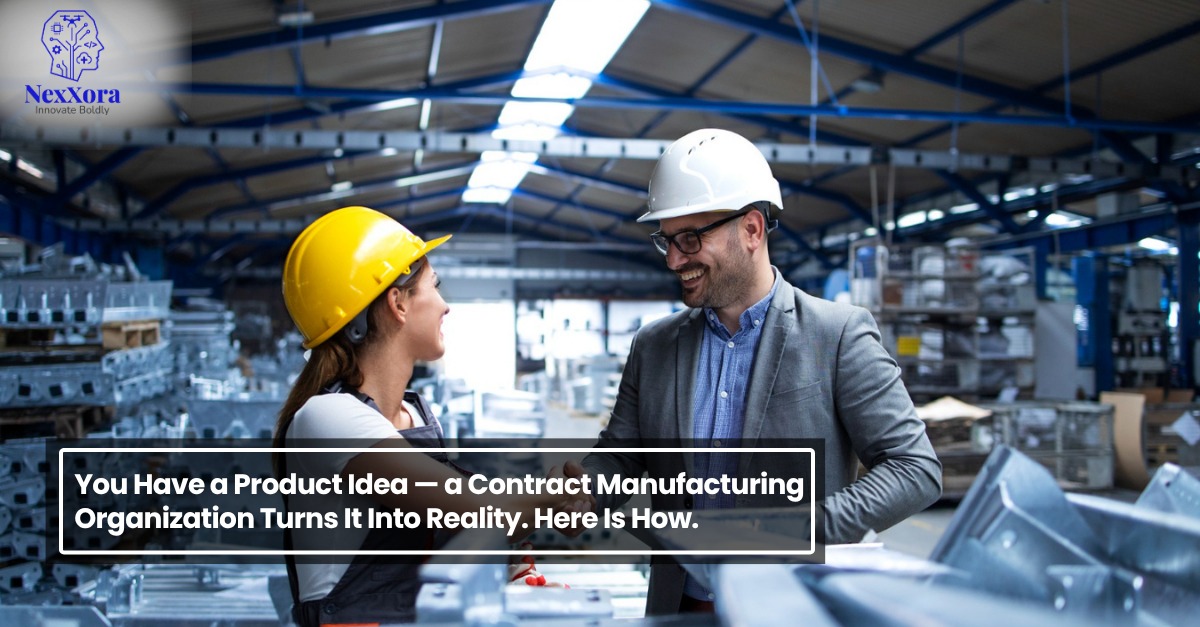
What Does a Contract Manufacturing Organization Do?
A contract manufacturing firm is an external party which renders full manufacturing services to the owner of a brand or to the product developer. The contract manufacturing operation requires the manufacturing company to handle all expenses for facilities and machinery and industrial personnel and regulatory compliance while delivering products that meet all client specifications.
From Concept to Design: Laying the Foundation
Contract manufacturer involvement usually starts at the stage of validation of concepts. The CMO engineering team works with the client to translate their general needs into specific technical documentation. The requirements which need to be met include BOM documentation and schematic drawings and mechanical envelope specifications and all requirements which include CE and FCC and RoHS and ISO 13485 for medical products. The process of creating an RTM (requirements traceability matrix) comes in at this stage..
Engineering, Prototyping, and Validation
Design for Manufacturability (DFM)
The primary advantage of contract manufacturers enables DFM, which stands for design for manufacturability, to become essential for their operations. DFM assessment evaluates product design through multiple factors which include tolerance requirements and component availability and assembly difficulty and yield performance. The team resolves issues that include irregular footprints and testing problems and excessive PCB stack-up layers and mechanical weaknesses before they start building their production tools. The solution reduces production problem-solving expenses by 40 to 60 percent when compared to traditional methods.
Rapid Prototyping and Testing
Modern contract manufacturing organizations leverage multiple rapid prototyping technologies to accelerate physical validation:
- FDM and SLA for preliminary stage mechanical housings
- CNC machining for functional prototype manufacturing using metals and plastics, with high precision machining capabilities
- Low volume PCB manufacture along with surface mount technology assembly for DVT
- ICT and JTAG for board level fault isolation
Iteration and Optimization
The data collected from each prototype iteration is then fed back into the CAD and EDA process flow. A good contract manufacturing company keeps track of all versions of the design file, and the ECO process can be traced back to all tests done previously..
Material Sourcing and Supply Chain Setup
A contract manufacturing organization brings established supplier relationships and procurement leverage that an independent product developer cannot replicate easily. Key activities include:
- Components qualified from multiple sources to avoid reliance on a single source
- Vendor-managed inventory (VMI) and Kanban replenishment systems
- Component authentication using X-ray and component traceability databases
- Long-lead time component management for ASICs, RF modules, and displays
According to Deloitte Global Manufacturing Outlook 2024, 74 percent of manufacturers consider supply chain resiliency to be a key concern in their strategy, and thus highlights the importance of working with a contract manufacturer that enjoys an extensive supplier base.
Scaling from Prototype to Production
Pilot Runs and Process Validation
Before full-scale manufacture is considered, the contract manufacturer will run pilot assemblies, usually between 50 and 500 units, to test out the process capability indices (Cpk), assembly yield rate, and cycle time. The SPC control charts are put in place for all CTQ measurements. Other tools used at this stage include FAI and PFMEA to identify potential failure modes early on.
Full-Scale Manufacturing
After the completion of the pilot run for validation purposes, the next step involves entering into high-volume production runs. In a modern-day CMO facility, the utilization of Industry 4.0 technologies such as automated optical inspection, machine vision systems, and MES ensures that high-quality standards are maintained on a large-scale level. The OEE dashboards provide real-time information about uptime, yield, and throughput.
Quality Control and Compliance Standards
Quality assurance in a contract manufacturing organization is not limited to end-of-line inspection. It is embedded across the entire value stream:
- IQC is a check of quality on incoming parts based on AQL (Acceptable Quality Level)
- IPQC checks quality during the manufacturing process at certain control points
- FQC covers functional testing, burn-in test, and environmental stress screening
- ISO 9001:2015 (or industry standard, e.g. IATF 16949 for automotive industry; ISO 13485 for medical devices) compliant documentation controls
Packaging, Logistics, and Delivery
The final part of what is usually involved in the scope of operations of a contract manufacturing company consists of contract packaging and labeling, as well as logistics for the last mile. Added value services include kitting, serialization, barcoding, and the preparation of customs documents. All this makes for an end-to-end delivery process to ensure that the finished product reaches its destination in marketable form.

Key Benefits of Working with a Contract Manufacturing Organization
- Accelerated time to market: Use of an existing production facility prevents spending months in setting up the factory.
- Efficient capital use: No need for any CAPEX on machine tools and facilities for manufacturing.
- Scalability: Ability to scale production volume up or down based on market demands.
- Specialized skills: Access to experts with knowledge of DFM, EDA software and regulatory compliance requirements.
- Risk Management: Built-in supply chain backup, process validations and quality control measures mitigate product failure risk.
Choosing the Right Manufacturing Partner for Your Product
Choosing an appropriate contract manufacturer involves assessing factors such as technical expertise, quality accreditation, supply chain sophistication, and vertical industry knowledge. Critical elements include the ability to manufacture products within your specific product line (electronics, automotive, consumer, or medical), ISO or IATF accreditation, internal engineering expertise in design for manufacturing and design validation testing, and openness regarding the new product introduction process. Conducting a site inspection and checking references from current customers is highly advisable.
Common Challenges and How to Overcome Them
Even with the right contract manufacturing organization, challenges can arise. Being prepared helps:
- Protecting intellectual property (IP): Utilize NDA, design escrows, and BOM division methods
- Miscommunication and lack of communication: Develop an effective communication process with clear escalation procedures and shared dashboards for monitoring projects
- Component availability: Ensure you work with a CMO with AVLs and long lead-time component management capabilities
- Process drift in mass manufacturing runs: Implement Control Plans and audit SPC charts frequently
Frequently Asked Questions (FAQs)
- What does a contract manufacturing organization actually do?
A contract manufacturing organization handles the full production process — from component sourcing and assembly to testing and packaging — on behalf of the client brand owner.
- How long does it take to go from prototype to full production?
Depending on product complexity, the NPI (New Product Introduction) cycle through a contract manufacturing organization typically takes 3 to 9 months, including DVT, pilot run, and process validation.
- What certifications should a contract manufacturing organization hold?
Look for ISO 9001:2015 as a baseline; IATF 16949 for automotive, ISO 13485 for medical, and IPC-A-610 compliance for electronics assembly are key industry-specific credentials.
- Can Nexxora handle both hardware engineering and contract manufacturing under one roof?
Yes. Nexxora provides integrated hardware engineering — including PCB design, DFM, and prototyping — combined with full contract manufacturing and assembly services from its Chennai facility.
- Does Nexxora support startups or only established companies?
Nexxora works with both. Their scalable production model and concept-to-product service structure make them equally accessible for early-stage startups and established enterprise clients.
- How does Nexxora ensure quality across high-volume production runs?
Nexxora applies IQC, IPQC, and FQC checkpoints across the production line, backed by AOI, functional testing, and SPC-driven process control to maintain consistent quality at scale.
Final Thoughts: Bringing Your Idea to Life Successfully
However innovative the product idea may be, its realization entails the need for effective engineering, manufacturing, and logistics operations. The contract manufacturer is your best bet here as they will take away all your headaches related to capitalization, technical know-how, and logistics infrastructure. If you are considering contract manufacturing in Chennai, you should definitely pay attention to Nexxora Technology.
Nexxora Technology provides a comprehensive stack of services which includes such things as hardware engineering, rapid prototyping (FDM, SLA, MJF), PCB design with DFM support, CNC machining, and contract electronics manufacturing. It means that when you turn to them, they will be able to help you with bringing a product through to mass production. In addition to that, Nexxora Technology boasts experience in automotive, IoT, wearables, and industrial verticals, which will make the cooperation even more beneficial for your product team.





No comment