
- Introduction: Power Quality as a Critical Business Variable
- Key Challenges in Power Quality Management
- Impact of These Challenges on Operations
- Technical Solutions: How a Servo Stabilizer Works
- Benefits and Real-World Applications
- Future Trends and Innovations
-
Frequently Asked Questions (FAQ)
- Q1: Explain what a servo stabilizer is and how it differs from a relay stabilizer.
- Q2: What is the input voltage range for a servo stabilizer?
- Q3: How fast does a servo stabilizer stabilize voltage variations?
- Q4: Is it possible for a servo stabilizer to enhance power factor and lower electricity expenses?
- Q5: What is the general ROI period of installing a servo stabilizer?
- Q6: Can we use servo stabilizers for unbalanced three-phase loads?
- Conclusion: A High-Impact, Low-Risk Investment
Introduction: Power Quality as a Critical Business Variable
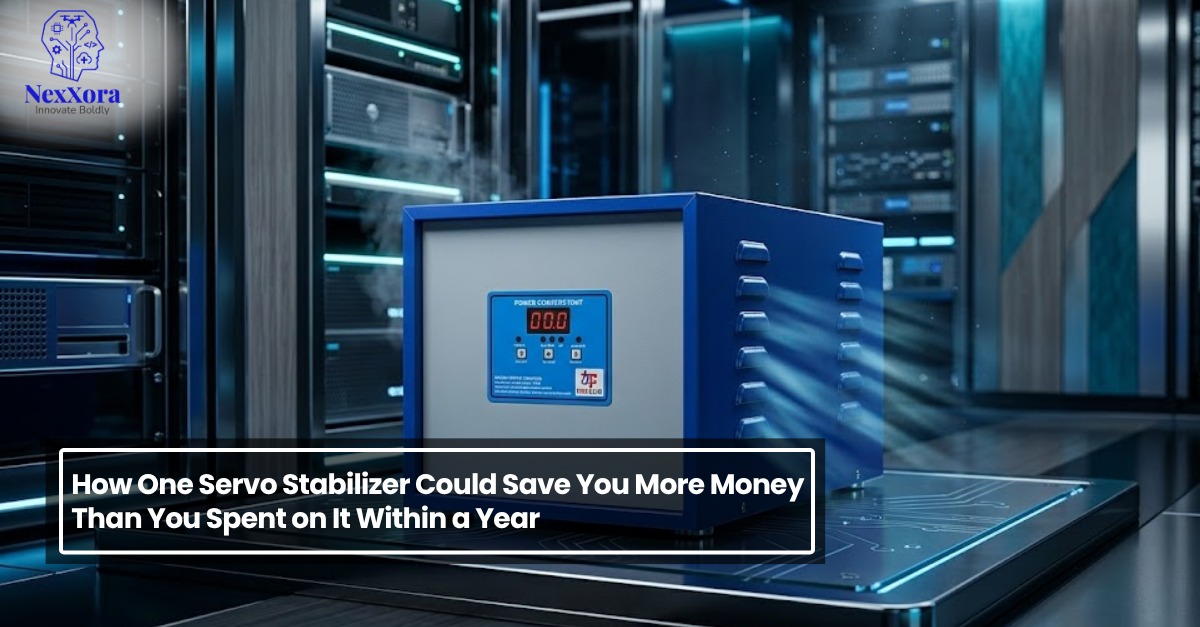
In today’s highly connected world of industry, power quality is no longer an auxiliary issue; rather, it is a key variable without which survival is impossible. Voltage fluctuations, harmonics, and transients can have disastrous consequences by affecting efficiency and causing damage while increasing costs. They can be costly in a manufacturing plant or data center.Servo stabilizers can be described as electro-mechanical feedback systems used to regulate voltage outputs. In contrast to the traditional tap-changing transformers, a servo stabilizer consists of an autotransformer controlled by a servo mechanism and error detection system that ensures voltage regulation. It ensures an undisturbed supply of alternating current and protects connected devices from overvoltage and undervoltage conditions.The key question raised here is: Is a servo stabilizer worth buying? Or simply put, does it justify its cost? This blog provides a clear answer and shows how even one servo stabilizer can bring you financial benefits that outweigh the cost of installation.
Key Challenges in Power Quality Management
Voltage Fluctuations and Grid Instability
The industrial power grid system in South Asia and developing economies experiences persistent voltage instability, which ranges from ±10% to ±25% of the nominal voltage level. Such imbalances are caused by unpredictable load shedding, impedance imbalance in feeders, and sporadic renewable energy input in distribution networks. In industries that rely on servo stabilizers for process control, an instantaneous drop below the required voltage levels is enough to cause process disruptions that lead to expensive downtime.
Equipment Vulnerability
CNC machines, VFD drives, medical diagnostic tools, and precision measurement devices are engineered to function in narrow voltage tolerance bands, which usually correspond to ±5% of their nominal power source. Operation beyond this range leads to winding insulation damage in motors, higher leakage currents in power sources, and erratic PLC behavior. The combined dielectric stress causes a reduction in equipment MTTF.
Unplanned Downtime
Unplanned downtime is considered one of the most critical hidden expenses in manufacturing operations. Based on benchmark estimates, the cost of an hour of unplanned manufacturing downtime can be anywhere from $50,000 to $200,000. This figure includes idle labor, wasted material due to spoilage, delivery penalties, and extra repair expenses. Voltage-induced failures are among the top three causes of unplanned downtime in industrial operations.
Increased Maintenance Costs
Cycles of reactive maintenance based on voltage-related equipment failures increase not only the cost of materials but also that of labor. Replacing burnt-out motor windings, faulty capacitors, and damaged servo controllers is expensive, particularly when conducted urgently. The installation of a servo stabilizer ultimately breaks this maintenance cost cycle by removing the primary source of electrical stress.
Impact of These Challenges on Operations
Financial Losses
Financial impacts of poor power quality are related to replacement costs of equipment, loss in production due to frequent breakdowns, energy wastage, and compliance failure penalties. Plants using no voltage stabilization solutions incur 8–15% higher maintenance cost in a year than those equipped with stabilizers.
Reduced Equipment Lifespan
According to IEEE, every increase in temperature level of electrical insulation by 10°C decreases its lifetime by half. Voltage variations result in increased current flow; thus, creating I²R losses. Within a year, voltage variability can decrease the lifespan of motor and transformer components by 20–40%.
Energy Inefficiency
In case of overvoltage in the electrical system, electrical loads use excess reactive power. Therefore, the power factor (PF) reduces significantly below acceptable levels (typically PF<0.85 for industrial applications). Reactive power consumption is charged as a supplementary charge for energy utilization; moreover, it causes I²R losses in the conductors. Servo stabilizer helps to keep the voltage constant with ±1% accuracy.
Operational Instability
Indications of voltage stability problems include fluctuating speeds in induction motors, fluctuating lights from lighting systems, corrupted data in industrial computers, and unwanted operation of protective relays. All of these factors reduce the consistency of the manufacturing process, leading to poor-quality products and increased human error.
Technical Solutions: How a Servo Stabilizer Works
Core Operating Principle
The working of the servo stabilizer is based on the concept of automatic voltage regulation through a negative feedback system. The control circuit constantly monitors the output voltage through a precise voltage sensing transformer. In case the voltage deviates from the desired set-point value either by falling or rising, the servo motor starts rotating the variac in the corrective direction. It takes about 25 – 50 milliseconds for the servo mechanism to correct the voltage, which is enough to compensate for most industrial voltage irregularities.
Key Components
There are four essential sub-systems in the design of a servo voltage stabilizer:
- Servo Motor: An AC/DC servo motor that provides sufficient torque but with minimum inertia to adjust the variac in response to the error generated by the control circuit.
- Variable Autotransformer (Variac): A toroidial or linearly wound transformer that has movable carbon brushes and alters the turns ratio, thus adding corrective voltage in the output circuit.
- Sensing and Control Circuit: A computer-controlled or analog comparator circuit that generates PI error control signals for operating the servo motor precisely.
- Correction Transformer (Buck-Boost): Series transformers used for adding/subtracting corrective voltages from the mains supply to obtain the required output.
Types of Servo Stabilizers
Servo stabilizers are made available in single phase and three phase designs, the latter being sub-classified into:
- Three Phase Balanced (Column type): Only one servo motor controls the stabilization of all three phases at once – suitable for balanced load applications.
- Three Phase Unbalanced (Tri-Limb type): One dedicated servo motor for each of the phases – preferred for large-scale unbalanced load applications where per-phase voltage correction is needed.
- Oil Cooled Servo Stabilizers: Recommended when high-capacity installations (over 100kVA) need better thermal environment control.
Performance Parameters
The main specifications used in determining the operational capability of a servo stabilizer are as follows:
- Input Voltage Range: Usually between ±20%-±35% of the nominal input (for example ±20-35% for 415V).
- Output Voltage Accuracy: ±1% of the set output voltage.
- Correction Rate: Between 15-50V/second dependent on servo motor capacity.
- Efficiency: 97%-99% over the entire operating load spectrum.
- Response Time: 20-50 ms when within the correction bandwidth.
Benefits and Real-World Applications
Immediate Cost Savings
As soon as a servo stabilizer is installed, instant and measurable savings are realized in a number of cost areas. The absence of breakdowns due to voltage fluctuations means that there will be no additional expenses on repairs in the maintenance schedule. The protection of variable speed drives and soft starters from voltage fluctuations ensures that costly one-time repairs, estimated between ₹50,000 and ₹5,00,000, do not occur.
Energy Efficiency Optimization
Due to the constant adjustment of the supply voltage to the optimum level according to the loads of industrial facilities, a servo stabilizer will ensure savings of up to 3–8% of energy. If a company spends ₹10 lakhs on electricity each month, then annually, its savings will amount to ₹3.6-9.6 lakhs.
ROI in a Year
The ROI of the servo stabilizer installed for an industrial application can be expected to give the following annual savings:
- Savings from preventing equipment damages: Rs.2-4 lakh/yr
- Energy saving benefits from improved efficiency (5% saving from total cost of Rs.10L per month): Rs.6 lakhs/yr
- Savings from lower maintenance costs: Rs.1-2 lakhs/yr
- Savings due to avoidance of downtime (two incidents in a year @ Rs.2L each): Rs.4 lakhs/yr
Total Annual Benefit = Rs.13-16 lakhs vs Cost of 100 kVA Servo Stabilizer ~Rs.8-12 Lakhs; Payback Period ~8-12 Months
Industry Applications
Servo Stabilizers provide substantial value for multiple industries as listed below:
- Manufacturing Industries & Automotive: CNC machining centers, robotic welders, and assembly machines
- Textile Industries: High-speed looms, knitting machine, and dyeing machinery
- Healthcare Sector/Hospitals: Magnetic resonance imaging, CT scan machines, and surgical laser equipment
- Information Technology/IT/Data Centers: UPS systems, server, and networking equipment
- Food Processing Industries: Refrigerator compressors, conveyor systems, and packing lines
- Telecom: Base transceiver station/BTS equipment, and microwave link equipment
Future Trends and Innovations
IoT-Based Smart Stabilizers
State-of-the-art servo stabilizers are being provided with IoT capabilities for telemetry, remote diagnostics, and online performance analysis. Data regarding input/output voltages, load currents, power factor, Total Harmonic Distortion (THD), and power consumption are uploaded to central dashboards, allowing for better maintenance planning and predictive fault detection. As experts in IoT engineering, NexXora Technologies is a pioneer in incorporating these innovative monitoring features in industrial power products.
Voltage Management Based on Artificial Intelligence
IoT technologies and machine learning algorithms have found applications in predictive voltage management within advanced servo stabilizer control systems. Based on historical grid performance and load demand patterns, intelligent stabilizers will pre-adjust the variac to minimize response time to disturbances.
Energy-Efficient Designs
In today’s designs of the servo stabilizer, amorphous core correction transformers, efficient servo motors with PM rotor construction, and SiC-based power semiconductors in control circuits are some of the innovations that drive the efficiency of the stabilizer beyond 99% while minimizing self-consumption losses and decreasing heat dissipation during operation.
Servo Stabilizers in the Smart Grid Environment
With an increasing number of DERs, which include rooftop solar PV installations and BESS on industrial complexes, the design of servo stabilizers is evolving to work within smart grid environments using IEC 61850 and MODBUS TCP/IP communication protocols for voltage regulation, reactive power compensation, and smooth switching between grid-connected and isolated modes.
Frequently Asked Questions (FAQ)
Q1: Explain what a servo stabilizer is and how it differs from a relay stabilizer.
The servo stabilizer utilizes a closed-loop servo-motor mechanism to make smooth and continuous adjustments (+-1% accuracy) in voltage correction, unlike a relay stabilizer that switches taps using discrete steps (+-5%-8%) to achieve voltage correction.
Q2: What is the input voltage range for a servo stabilizer?
Industrial servo stabilizers have an input voltage range of +-20% to +-35% of nominal voltage levels, for instance, 300V-470V for a 415V three-phase system, with the output voltage controlled within 1% accuracy of the set voltage level.
Q3: How fast does a servo stabilizer stabilize voltage variations?
It takes about 15-50V per second to stabilize voltage levels in a servo stabilizer, with a total response time of 20-50 milliseconds in correcting transient voltage variations within its correction range.
Q4: Is it possible for a servo stabilizer to enhance power factor and lower electricity expenses?
Yes, because by stabilizing the supply voltage within its optimal level, a servo stabilizer helps minimize the reactive power component of the load to enhance power factor and reduce electrical energy costs by 3-8%.
Q5: What is the general ROI period of installing a servo stabilizer?
In most medium-scale factories, the combined cost benefits due to energy conservation, protection of machines, and avoiding any downtime give a payback period of 8 to 12 months. This is therefore an investment with a return on investment less than one year.
Q6: Can we use servo stabilizers for unbalanced three-phase loads?
Yes, since tri-limb (individual three-phase) servo stabilizers offer phase-wise voltage regulation.
Conclusion: A High-Impact, Low-Risk Investment
A servo stabilizer is no longer viewed as a passive protection device but as a high-impact capital investment that delivers measurable financial returns within a short operational cycle. By mitigating voltage fluctuations, preventing equipment failure, optimizing energy consumption, and minimizing unplanned downtime, it enables organizations to achieve substantial cost savings that often exceed the initial investment within the first year.
Nexxora Technologies leverages over 25 years of domain expertise in power electronics, embedded systems, and IoT-enabled infrastructure to deliver precision-engineered power quality solutions. Their approach integrates advanced control systems, real-time monitoring, and intelligent diagnostics to ensure consistent voltage regulation and asset protection. By aligning engineering excellence with performance-driven outcomes, Nexxora empowers industries to enhance operational reliability, reduce lifecycle costs, and accelerate ROI through next-generation servo stabilizer solutions.






No comment