
- Introduction: The World Is Getting Smarter
- What Are IoT Devices?
- How Do IoT Devices Work? The Four-Layer Architecture
- Types of IoT Devices
- Consumer IoT: Smart Living, Every Day
- Industrial IoT (IIoT): Where the Real Power Lies
- Key Technical Features of IoT Devices
- Benefits of Using IoT Devices
- Frequently Asked Questions (FAQs)
Introduction: The World Is Getting Smarter
The research conducted by Statista in 2024 predicts that the number of devices connected to the Internet of Things is going to exceed 29 billion by 2030. That is four devices per human being on the planet. No longer is this information reserved for the engineer; it is imperative information for the business owner, the healthcare worker, the urban planner, and the consumer.
What Are IoT Devices?
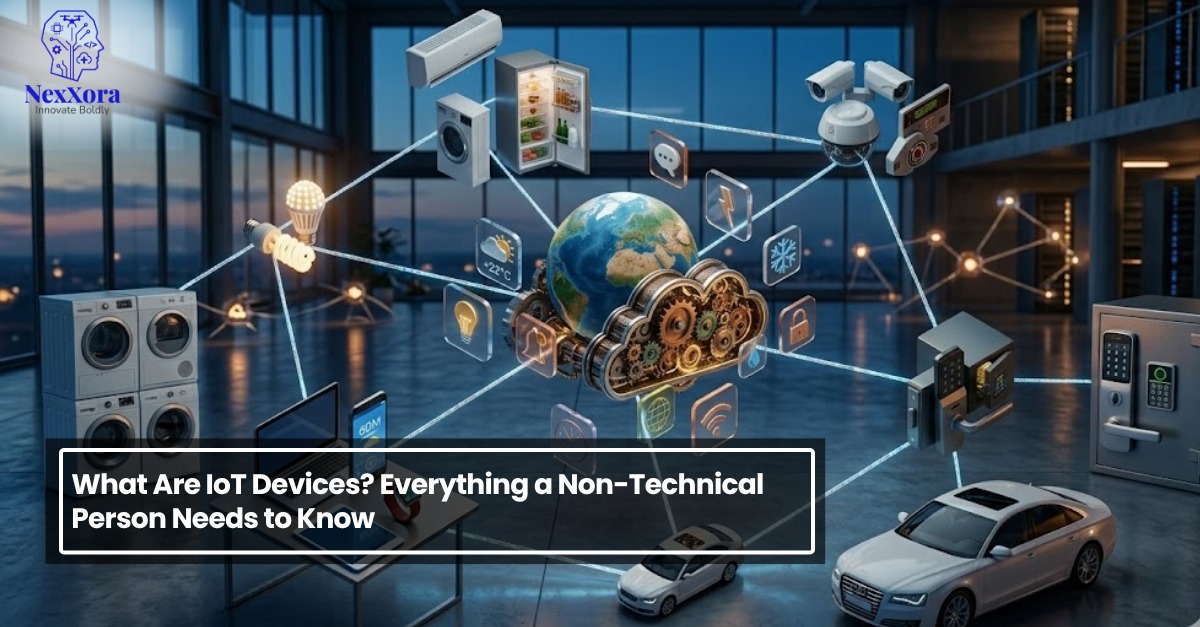
IoT devices, or Internet of Things devices, are those physical things which are embedded with sensors, microprocessors, firmware, and wireless communication components that enable them to collect, communicate, and act upon information without human intervention or interaction. IoT devices can be thought of as “things” that have been enabled with the ability to sense their environment, communicate with each other, and act intelligently.
The phrase “Internet of Things” was originally coined in the year 1999 by a British technologist named Kevin Ashton. However, the concept has moved beyond its original scope. Today, the Internet of Things includes everything from a cardiac monitor strapped to a patient’s wrist to a pressure sensor embedded inside an oil pipeline. What unites all these devices is a common operating principle:
- Sense the environment with embedded sensors
- Send information using wireless communication protocols
- Process information at the edge or in the cloud
- Act based on the result with automated responses or alerts
It is essential to understand the difference between IoT devices and other internet-connected devices. A laptop or smartphone is a computing device. An IoT device is a device designed for a particular task. It is always monitoring a parameter, for example, temperature, pressure, motion, vibration, composition, etc.
How Do IoT Devices Work? The Four-Layer Architecture
Every successful IoT system has four different layers of functionality. Understanding this helps demystify how a small sensor on a factory floor can send a notification to a manager’s smartphone thousands of miles away.
Layer 1: The Perception Layer (Sensing)
This is where physical data comes into the digital world. Sensors such as temperature probes, accelerometers, optical sensors, RFID, and LiDAR modules pick up changes in the physical environment and translate them into an electric current. At this layer, actuators can take physical actions based on a command..
Layer 2: The Network Layer (Connectivity)
Data collected has to be sent to a place for processing. IoT devices utilize different wireless communication protocols depending on their applications. These include:
- Wi-Fi, Bluetooth – for small-range consumer applications
- Zigbee, Z-Wave – for smart home mesh networks
- LoRaWAN, NB IoT (Narrowband IoT) – for long-range, low-power applications
- 5G – for applications requiring low latency, such as self-driving cars or live surgeries
Layer 3: The Processing Layer (Edge and Cloud Computing)
Once the data is available, it must be processed. Traditionally, processing happens exclusively within the cloud servers. However, with the advent of modern IoT systems, edge computing is becoming more popular. With edge computing, processing happens directly on the IoT device itself. This helps minimize latency, maximize bandwidth, and ensure continued functionality even when the network is unavailable. A smart traffic camera, for example, is a classic edge computing scenario because it recognizes the type of vehicle without sending raw video feed to a data center.
Layer 4: The Application Layer (Insights and Action)
The processed data is then analyzed and sent to a dashboard, a mobile app, a software platform, or a control system. This is when a facility manager receives a notification, an algorithm adjusts a logistics route, or a physician receives an automatic notification of an abnormal patient reading.
Types of IoT Devices
IoT devices range across an enormous variety of applications. Devices can be broadly classified into two major categories: Consumer IoT and Industrial IoT (IIoT). Each type of device has its own set of applications, technical constraints, and utilities.
Consumer IoT: Smart Living, Every Day
Consumer IoT refers to the class of IoT devices that people normally encounter in their day-to-day lives. Devices in this category are meant for enhancing people’s comfort, health, fitness, and energy efficiency at an individual or household level. Some examples of Consumer IoT devices are as follows:
- Smart thermostats such as Nest or Ecobee, which automatically adjust temperature based on individual preference
- Wearable fitness tracking devices that measure HRV, SpO2, and sleep cycle architecture
- Smart speakers with integrated NLP engines that can interpret voice commands
- Connected home security cameras with integrated AI-driven motion classification capabilities
- Smart appliances such as washing machines with self-diagnosis capabilities or ovens with automated cooking cycle control
In its report published in 2023, the McKinsey Global Institute emphasized the potential economic value of consumer IoT in health monitoring applications, which could reach $170-$289 billion annually by 2030. The report indicated that these figures would be achieved primarily through the early detection of chronic diseases and reduced hospital readmission rates.
Industrial IoT (IIoT): Where the Real Power Lies
Whereas the Consumer IoT is getting all the attention, the real action is happening in the Industrial Internet of Things (IIoT), which is driving the most significant economic transformation. IIoT is the use of IoT technology in manufacturing plants, energy grids, logistics networks, agricultural settings, and even smart cities. Some of the major IIoT use cases include:
Predictive Maintenance
Vibration sensors installed in industrial machinery can sense micro-variations in motor performance, sometimes even weeks before an actual failure is about to happen. This enables maintenance staff to take proactive measures to prevent costly downtime for manufacturers who lose an average of $50,000 per hour.
Precision Agriculture
Soil moisture sensors, weather sensors, and drone-mounted cameras with multispectral sensors help inform agricultural practices at the individual plot level. IIoT-driven precision farming has been used to reduce water consumption by up to 40% while improving crop yield consistency.
Smart Grid Management
Distributed IoT sensors can monitor electricity transmission lines in real-time and automatically reroute electricity around faults. This minimizes the duration of power outages and facilitates the seamless integration of RE sources with the grid.
Supply Chain Visibility
IoT-based RFID and GPS technology offer end-to-end shipment tracking down to the level of each package. This technology records the package location, temperature, humidity, and any handling impacts during the course of the shipment. The World Economic Forum published a report on the “Future of Production 2024,” which reported that IIoT-adopting industries have reduced their 30-50% downtime by 30-50%.
Key Technical Features of IoT Devices
Not all IoT devices are created equal. The following technological characteristics define the level of ability, reliability, and security a given IoT device will offer in the real world:
Low-Power Design
IoT devices use battery power for months or years through “energy harvesting” technologies and “duty cycling,” whereby the IoT device briefly wakes up to communicate and then immediately goes back to a deep sleep state. This is especially important for IoT deployments in inaccessible or remote areas.
Real-Time Data Transmission
Latency constraints vary greatly from application to application. A remote water meter, for instance, might be able to accommodate several minutes’ worth of data latency. However, a car’s obstacle detection system, on the other hand, cannot accommodate a processing latency of over a handful of milliseconds.
Interoperability
Standards-based approaches such as Matter, a smart home protocol backed by Apple, Google, and Amazon, OPC-UA for industrial automation, or MQTT, a lightweight message queuing protocol, allow IoT devices from different manufacturers to communicate within a single ecosystem.
Security Architecture
For IoT devices, robust devices are required to have end-to-end TLS/SSL encryption, device authentication, over-the-air firmware updates, and hardware-based secure elements for protection against physical attacks or software-based key extraction.
Scalability
For IoT platforms, thousands or even millions of devices’ concurrent connection requirements mean that IoT platforms have to be robust. This means that there is a lot of emphasis on protocol efficiency, message queue management, and distributed backend infrastructure.
Benefits of Using IoT Devices
The justification for IoT devices is based on quantified results across various aspects. The quantified benefits of IoT devices include the following:
- Operational efficiencies: Manual inspection processes are replaced with automated monitoring..
- Resource savings: Smart buildings use IoT technology to regulate HVAC, lighting, and water usage based on occupancy levels.
- Decision-making: Senior management is provided with detailed information on operational activities in near-real-time rather than batch reporting.
- Healthcare: Remote patient monitoring through IoT devices minimizes unnecessary hospitalizations.
- Revenue growth: IoT technology provides opportunities for product-as-a-service and outcome-based pricing.
However, the discussion on the benefits will not be complete without a mention of the challenges. IoT cybersecurity is a major concern. A report on threats by Palo Alto Networks in 2024 revealed that 57% of IoT devices in the enterprise environment are vulnerable to medium- or high-severity attacks. Data privacy, regulatory compliance, and management of the devices in the future are some of the key areas that require continued organizational focus
IoT devices have moved well beyond novelty — they are now foundational infrastructure for businesses that want to compete in data-driven markets and for communities seeking smarter, more resource-efficient environments. From a wearable health monitor to an industrial vibration sensor on a factory floor, every IoT device represents a bridge between the physical and digital worlds, converting raw environmental data into actionable intelligence. As the global count of connected IoT devices surpasses 29 billion by the end of this decade, organizations that understand, plan for, and responsibly deploy these technologies will hold a decisive advantage. For businesses ready to move from understanding to implementation, NexXora Technologies offers comprehensive, end-to-end IoT Integration Services — spanning IoT Security, Industrial IoT, Wearable IoT, IoT Cloud, IoT Analytics, IoT Mesh, and Blockchain IoT Solutions — built to support organizations at every stage of their connected technology journey. Whether you are at the exploration stage or ready to scale an existing IoT infrastructure, nexxora.technology/iot is a practical and informed starting point.
Frequently Asked Questions (FAQs)
Q1. What does IoT stand for?
IoT stands for Internet of Things. It is a network of physical devices with sensors, software, and connectivity that collect and exchange data over the internet.
Q2. Are IoT devices the same as smart devices?
No. All IoT devices are smart, but not all smart devices are IoT devices. IoT devices are built for specific tasks such as sensing, monitoring, or controlling.
Q3. Do IoT devices always need an internet connection to work?
No. Many IoT devices can work through local networks like Zigbee, Bluetooth mesh, or Z-Wave. They can also process data locally and connect to the cloud only when needed.
Q4. What IoT services does NexXora Technologies provide?
NexXora Technologies offers complete IoT Integration Services, including design, deployment, consulting, and support. Their services include IoT Security, Industrial IoT, Cloud Integration, Wearable IoT, Analytics, IoT Mesh, and Blockchain IoT Solutions.
Q5. Which industries does NexXora Technologies serve with IoT solutions?
NexXora Technologies serves industries such as automotive, medical, telecommunications, and wearable technology. Their solutions help businesses connect devices, improve operations, and gain real-time insights.
Q6. How does NexXora Technologies approach IoT security?
NexXora Technologies treats IoT security as a core part of every solution. Their approach includes device authentication, data encryption, secure firmware updates, and network segmentation.
Conclusion
However, IoT devices are no longer a new technology. Instead, they have become essential for businesses and smart communities. IoT devices connect the physical and digital worlds by providing insights from real-time data. IoT devices, such as wearable health devices, are used to improve efficiency, automation, and decision-making. As the number of IoT devices increases, organizations that use IoT devices responsibly are at a great competitive advantage. Therefore, organizations that are looking for IoT Integration Services have a reliable partner in NexXora Technologies. The services provided by NexXora Technologies include IoT Security, Industrial IoT, Wearable IoT, IoT Cloud, IoT Analytics, IoT Mesh, and Blockchain IoT Solutions. For businesses that are planning to use IoT devices, they have a reliable starting point with NexXora Technologies.



No comment